
Introduction: The Arcade Category in Sweepstakes
Fish games are the oddball of the sweepstakes casino world — a category that looks nothing like slots, plays nothing like table games, and still generates serious SC activity for the platforms that carry it. Rooted in the arcade fish-shooting cabinets that spread through Asian gaming markets in the 2010s, these games migrated to online social casinos and eventually found a home in the sweepstakes model, where they trade the purely social format for a redeemable SC twist.
The broader social casino market that feeds this niche is substantial. According to Business Research Insights, the global social casino games market was valued at $8.15 billion in 2025, with projections reaching $15.67 billion by 2034. Fish games occupy a sliver of that total, but it’s a sliver with a dedicated player base that values the genre’s interactive mechanics over the passive spin-and-watch rhythm of slots. If you’ve been cycling through the same slot lobbies and want something that asks more of your attention, fish tables are worth understanding.
How Fish Games Differ From Traditional Slots
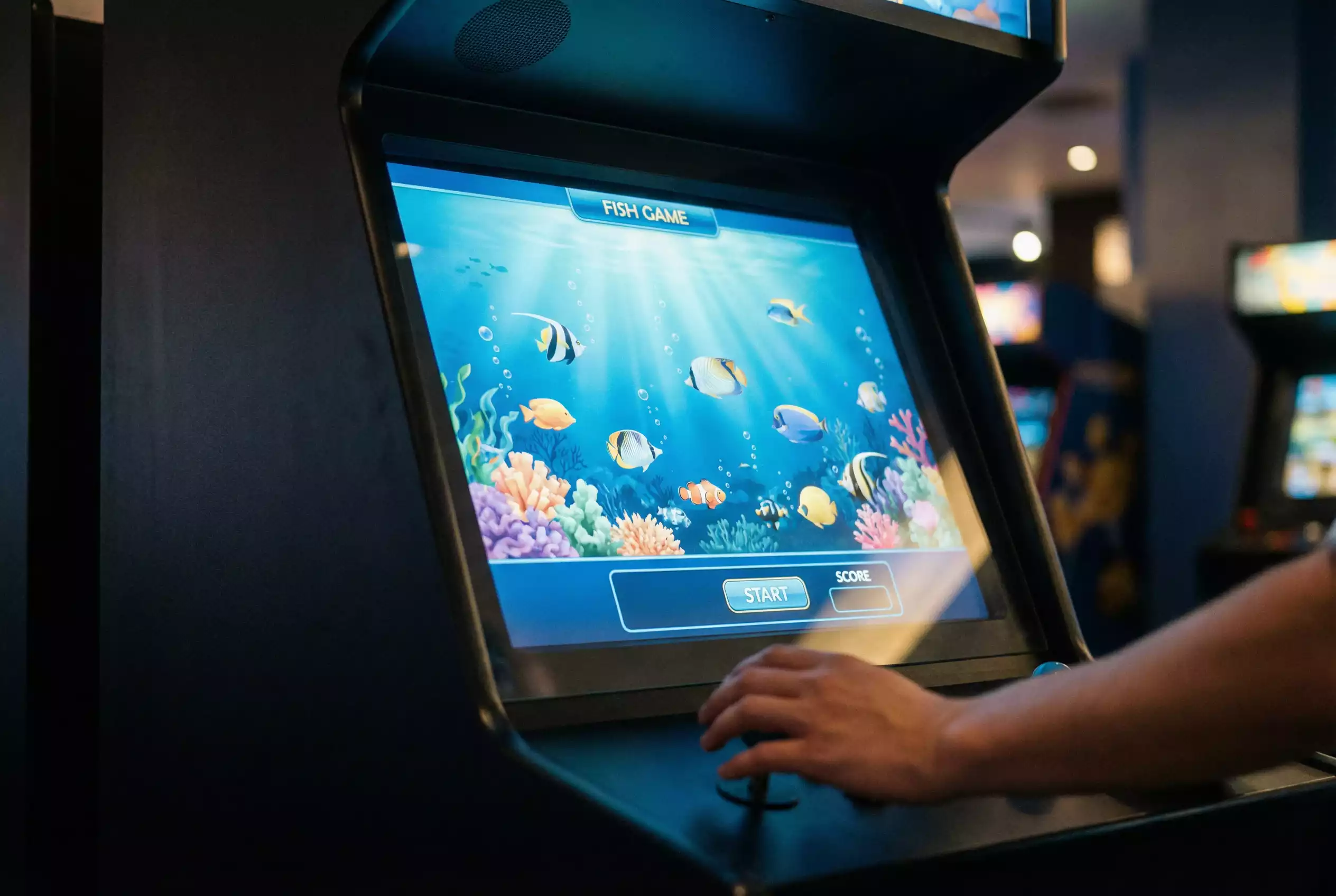
The core mechanic of a fish game is shooting. You’re presented with an underwater scene populated by fish of various sizes, colors, and point values. You aim a cannon — using a mouse click or screen tap — and fire projectiles at targets. Each shot costs a set amount of currency (GC or SC depending on which mode you’re playing). When a fish is hit and killed, it pays out its assigned value. Larger, rarer fish are harder to hit but pay substantially more. Some games add boss creatures or special targets that trigger bonus rounds with multiplied payouts.
This is fundamentally different from how slots work. Slots are outcome-determined: you press spin, the RNG generates a result, and the reels display it. Your input begins and ends with the bet amount. Fish games introduce aiming, timing, and target selection as variables. You decide which fish to shoot, when to fire, and how many shots to invest in a single target. The result is still governed by random number generation — each shot has a probability of killing its target, not a guaranteed outcome — but the player’s choices influence which probabilities they encounter.
The pacing is also different. A slot spin resolves in two to five seconds. A fish game session is continuous: targets swim across the screen in real time, and you fire as quickly as you want. This creates a faster burn rate on your balance if you’re not careful, but also a more engaging experience for players who find slot gameplay monotonous. The sensory design leans into the arcade heritage — bright colors, explosion effects, multiplier pop-ups — and the visual intensity is higher than anything in the typical slots lobby.
One important structural difference: fish games rarely publish an RTP figure. The return depends on your targeting accuracy, shot frequency, and the mix of targets you pursue, making a static RTP calculation less meaningful than it is for slots. This opacity is a drawback for data-driven players, and it’s one reason fish games remain a niche category rather than the main event at most sweepstakes casinos.
Top SC Casinos With Fish Game Libraries
Fish games aren’t available at every sweepstakes platform, and the depth of each casino’s library varies widely. With over 40 new operators launching in 2024 and 2025, according to Racine County Eye, some newer platforms have leaned into fish games as a differentiator from slot-heavy incumbents. Here’s the landscape.
Pulsz carries one of the larger fish game selections among mainstream sweepstakes casinos. Its library includes titles from providers like KA Gaming and others who specialize in the arcade genre. The games are playable in both GC and SC modes, and the integration is smooth — you switch currencies the same way you would for any other game type. Pulsz’s mobile PWA handles fish games reasonably well, though the aiming precision is slightly easier with a mouse than a touchscreen tap.
Stake.us, before its state-by-state availability started contracting, offered several fish game titles alongside its broader arcade category. The platform’s crypto payout infrastructure made it popular with fish game players who preferred fast SC redemption after winning sessions. Whether Stake.us remains accessible in your state is a question that changes faster than any list can track, so check availability before assuming.
Several smaller platforms have built their identity specifically around fish games and arcade-style content. These niche operators tend to offer deeper fish game libraries — sometimes dozens of titles with different themes, target types, and bonus mechanics — but trade that specialization for a thinner overall casino experience. If fish games are your primary interest, a dedicated platform might offer more variety. If you want fish games as one option among many, the larger multi-category casinos like Pulsz are the safer bet.
Chumba Casino and LuckyLand Slots — the two largest platforms by revenue — do not currently feature fish games in their lobbies. Their catalogs remain focused on slots and a handful of table games. For the VGW-operated giants, the fish game audience apparently doesn’t justify the integration effort, which says something about the category’s position in the broader market: popular with a loyal subset, but not yet mainstream enough for every operator to carry.
Strategies and Skill Elements in Fish Tables
The skill component in fish games is real but bounded. You genuinely control which targets you aim for, how many shots you invest, and when you switch targets. Those decisions affect your outcomes. But the underlying hit probabilities are determined by the game’s RNG, and no amount of targeting precision can override a miss that the algorithm has already decided.
The most effective approach is bankroll-proportional targeting. Smaller fish have higher kill probabilities per shot but lower payouts. Larger fish and boss targets have lower kill rates but disproportionately high rewards. If your SC balance is modest, focusing on smaller targets extends your session and generates consistent small returns. If your balance is deep enough to absorb a string of misses, investing shots in high-value targets creates the potential for the kind of lump-sum returns that move the needle on your redeemable balance.
Shot timing matters in games where fish move across the screen at varying speeds. Firing at a target that’s about to leave the screen wastes ammunition — you’ve spent the SC on the shot, but the fish escapes before the kill probability resolves. Waiting for targets to enter the center of the playfield, where they spend the most time in your firing zone, is a basic efficiency play that reduces wasted shots.
Special weapons and power-ups appear in most fish game titles, usually triggered by accumulating kills or spending extra currency. These mechanics can dramatically shift the return profile of a session — a screen-clearing bomb that kills a dozen high-value fish at once is the fish game equivalent of hitting a slot’s bonus round. Use them strategically rather than automatically, and pay attention to whether the power-up cost is deducted from your GC or SC balance.
SC Earning Potential in Fish Games
Quantifying the SC earning potential of fish games is harder than for slots because the variable outcomes resist simple RTP calculations. What can be said is that the burn rate on fish games tends to be higher than on low-volatility slots. Shots fire in rapid succession, each one costing currency, and the natural rhythm of gameplay encourages continuous firing rather than paused decision-making. An aggressive player can cycle through an SC balance much faster at a fish table than at a slot, for better or worse.
The upside potential, however, can be significant. Boss kills and bonus rounds in fish games occasionally deliver payouts in the hundreds of SC from a single encounter — returns that would require a major bonus trigger on all but the most volatile slot games. These outcomes are rare and shouldn’t be expected, but they exist in the distribution, and they’re the reason fish game loyalists stick with the category.
For free players working with limited SC from daily logins and AMOE, fish games carry more risk per session than comparable time spent on low-volatility slots. The rapid shot cycle means your balance can drain in minutes rather than the gradual erosion that slots provide. If you’re building toward a redemption threshold on a tight SC budget, slots are the safer vehicle. If your balance has room for some variance and you want the interactive experience, fish games offer a change of pace — just go in with a session limit and the discipline to stop firing when you hit it.