
What the Numbers Actually Say About Free SC
- Sweepstakes casino gross sales hit $10.6 billion in 2024, with net revenue around $3.4 billion after prize payouts — larger than regulated US iGaming that year.
- Only about 12% of players ever spend money; the rest play entirely free, making SC accumulation strategies viable for the majority.
- Six states banned sweepstakes casinos in 2025, and analysts now forecast a 10% revenue decline in 2026 — the first contraction in the sector's history.
- Operators return 65–70% of Gold Coin purchases as SC prizes, meaning every dollar of free SC you earn carries roughly $0.65–$0.70 in real redemption value.
- VGW (Chumba, LuckyLand) still controls over 90% of the market, but 40+ new operators entered in 2024–2025, intensifying competition for free-play sign-up bonuses.
What Are Sweepstakes Casinos and Why They Exist
A sweepstakes casino is an online platform that offers casino-style games — slots, blackjack, roulette, poker — without requiring players to wager real money in the traditional sense. Instead, these sites operate on a dual-currency model: players use Gold Coins for entertainment and Sweeps Coins (SC) for the chance to redeem prizes with real cash value. The legal distinction hinges on a single principle borrowed from decades-old promotional sweepstakes law — if there is a free method of entry, and the outcome depends on chance rather than purchase, the activity does not meet the legal definition of gambling in most US jurisdictions.
That principle made sweepstakes casinos possible, but market demand made them enormous. In 2024, gross sales across the US sweepstakes casino sector exceeded $10.6 billion, producing approximately $3.4 billion in net revenue after prize payouts, according to data referenced in a KPMG industry primer drawing on Eilers & Krejcik Gaming's Social Sweepstakes Gaming Monitor. To put that in perspective, the entire US regulated online casino (iGaming) sector generated $10.7 billion in revenue across 2025 — the sweepstakes segment arrived at comparable scale without a single state gaming license.
The player base skews younger and more digitally native than many assume. Data from a Racine County Eye industry analysis shows that 58% of sweepstakes casino users fall between 25 and 44 years old. These are not retirees pulling slot levers out of habit. They are millennials and early Gen-Xers drawn to free-to-play mechanics that feel familiar from mobile gaming, combined with the added incentive that Sweeps Coins can turn into real money.
The "why" behind these platforms is as much legal arbitrage as it is product innovation. Traditional online casinos need state-by-state licensing — a process that, as of early 2026, is available in fewer than ten states. Sweepstakes casinos sidestep that bottleneck by operating under promotional sweepstakes law. Every player can receive SC for free (through daily logins, social media giveaways, or mail-in requests), which satisfies the "no purchase necessary" requirement. The purchase of Gold Coin packages — which happen to include bonus SC — generates the revenue. This structure has survived legal challenges for years, though that survival is no longer guaranteed in every state.
Bill Miller, President and CEO of the American Gaming Association (AGA), has been among the most vocal critics of this model. He has described sweepstakes operators as relying on "legal acrobatics" to circumvent state gaming regulation, arguing that unregulated operators — including sweepstakes casinos — cost the regulated gaming industry an estimated $17.3 billion in diverted revenue while targeting vulnerable communities without generating a cent in state gaming taxes.
The industry's defenders see it differently. They point to the AMOE (Alternative Method of Entry) as genuine proof that no purchase is required, and they note that many operators voluntarily implement responsible gaming tools. The tension between these two positions — are sweepstakes casinos a legitimate innovation or an unlicensed gambling operation? — defines the regulatory battles that will shape the sector throughout 2026 and beyond.
Gold Coins vs. Sweeps Coins — A Side-by-Side Breakdown
If you have read the previous section, you know the theory. Here is the practical reality, laid out so you can see exactly where these two currencies diverge and what that means for your play.
| Feature | Gold Coins (GC) | Sweeps Coins (SC) |
|---|---|---|
| Can you buy them directly? | Yes — GC packages are the primary revenue product | No — SC are distributed as free bonuses or through AMOE |
| Free acquisition methods | Sign-up bonus, daily logins, social media | Sign-up bonus, daily logins, social media, mail-in AMOE, GC purchase bonus |
| Redeemable for cash? | Never | Yes — typically at 1 SC = $1 face value |
| Games available | Full game library | Full game library (same games, different currency mode) |
| Wagering requirements | None — no redemption exists | Usually 1x playthrough before redemption |
| Minimum to redeem | N/A | Usually 50–100 SC ($50–$100 equivalent) |
| Legal purpose | Entertainment — establishes the "fun play" layer | Prize mechanism — satisfies sweepstakes law by offering free entry to win |
| KYC required? | No | Yes, before first redemption |
Free Sweeps Coins · the long run
Will Free Coins Ever Reach Redemption?
Free coins arrive every day, and the house edge takes a slice every time you play them. Whether your balance grows toward the redemption minimum or settles below it forever comes down to one number almost nobody tracks: how much you wager relative to what you hold.
How playing intensity changes everything
The mechanism is simple once you see it: each pass through your balance hands over the house edge, while the free stream refills it at a fixed rate. Those two forces balance at a specific level — and if that level sits below the redemption minimum, no amount of patience gets you there. Playing less is what makes the free route work.
Two numbers decide which operator is friendliest to a free player: how fast coins arrive and how high the redemption bar sits. A generous daily bonus paired with a 100 SC minimum can be slower than a modest one with a 25 SC minimum — and headline welcome offers say nothing about either.
For information and entertainment only; figures are modeled from the values you enter and assume average results. No purchase necessary to play or redeem; see the operator's official rules. 18+ (21+ where required); void where prohibited. If gambling stops being fun, call 1-800-GAMBLER.
The confusion most new players experience comes from a single design choice: both currencies are used on the same games. You can sit at the same virtual slot machine, toggle between GC mode and SC mode, and the only visible difference is the balance counter. But the legal and financial consequences of that toggle are enormous. A session in GC mode is entertainment with no cash outcome. A session in SC mode is, functionally, a sweepstakes entry with the potential for a real prize.
This is also where the "free" in social casino free SC gets its meaning. Because SC cannot be purchased directly, every Sweeps Coin a player holds was technically acquired at no cost. The GC package you bought for $19.99 gave you Gold Coins — the SC that came with it were a promotional bonus. Whether this distinction feels meaningful to you as a player depends on how you view the transaction. To the legal framework, it is everything.
One practical implication that often gets overlooked: GC balances are essentially unlimited. Platforms hand them out generously because they carry no financial liability. SC balances, on the other hand, represent a real obligation. Every SC in circulation is a potential cash prize the operator may need to pay out. This is why SC bonuses are smaller, why wagering requirements exist, and why redemption thresholds are set where they are. The operator's generosity has a direct cost when it involves Sweeps Coins — and that cost shapes every bonus, promotion, and daily reward you encounter.
Five Ways to Get Free SC Without Spending a Dollar
The sweepstakes model depends on free entry — which means the paths to accumulating Sweeps Coins without paying are not hidden features but structural requirements. Operators must offer them. The question is which methods deliver the most SC for your time.
No-Deposit Sign-Up Bonuses
The most immediate free SC comes at registration. Nearly every major sweepstakes casino offers a no-deposit sign-up bonus that typically ranges from 1 to 10 SC, along with a larger batch of Gold Coins. Chumba Casino, for example, has historically offered 2 free SC upon registration. Pulsz tends to offer a similar range. Stake.us has leaned toward larger GC packages with modest SC bonuses. The amounts are not life-changing — they are designed to let you test the SC ecosystem, see how games feel when real value is on the line, and experience the redemption process in miniature. With 40+ new operators having entered the market across 2024 and 2025, according to Racine County Eye, sign-up bonuses have become more competitive. Newer platforms sometimes offer larger initial SC packages to attract players from established brands.

Daily Login Rewards
Logging in each day is the most consistent free-SC accumulation method. Most sweepstakes casinos award a small SC amount — anywhere from 0.10 to 1.00 SC — simply for visiting the platform and claiming a daily bonus. Some platforms use a streak system, where consecutive daily logins increase the reward. A seven-day streak at certain casinos might push the daily reward to 0.30 or 0.50 SC, compared to 0.10 on day one. Over a 30-day month, consistent daily logins across two or three platforms can yield 5 to 15 SC — modest, but entirely free and reliable.
Social Media Giveaways
Sweepstakes casinos maintain active presences on Facebook, X (formerly Twitter), Instagram, and increasingly TikTok. Social media giveaways are a regular feature: operators post contests, quizzes, or engagement prompts (like, share, comment) with SC prizes. The payouts per event tend to be small — 1 to 5 SC for winners — but the frequency can be high. Some platforms run daily or near-daily social contests. The trade-off is time and attention: you need to follow the right accounts, respond quickly, and meet whatever engagement criteria the platform sets. For players who are already on these platforms, this is low-friction. For everyone else, it is optional but available.
Referral Programs
Most major sweepstakes casinos offer referral bonuses when you invite friends who create accounts and meet activity thresholds. Referral SC varies widely: some platforms offer a flat 5–10 SC per successful referral, while others tie the bonus to the referred player's engagement level. The practical limitation is obvious — you need a network of people willing to sign up. But for players with active social circles interested in free-to-play casino games, referrals can generate meaningful SC over time. Just verify the terms carefully, as some platforms require referred users to complete specific actions (like making a first GC purchase or playing a minimum number of games) before the referral bonus credits.
Mail-In AMOE Requests
The Alternative Method of Entry is the legal requirement that makes sweepstakes casinos possible — and it is also a real, usable path to free SC. Most platforms accept handwritten requests sent via postal mail. A standard AMOE request includes your name, registered email address, and a statement requesting free Sweeps Coins. The casino processes the request and credits SC to your account, typically within 7–14 business days. The amount varies by platform — commonly 2 to 5 SC per request, with limits on how many requests you can send per day or per week. At roughly $0.68 per stamped envelope, the math looks like this: one stamp buys you 2–5 SC, which carry an effective redemption value of $1.30–$3.50 based on the 65–70% payout rate. It is not fast, and it is not convenient, but it remains the purest expression of the "no purchase necessary" principle. Every legitimate sweepstakes casino is required to honor it.
Top Free-SC Casinos Ranked by the Data
Most sweepstakes casino rankings are barely disguised affiliate tables — whoever pays the highest commission gets the top slot. But when you are playing for free SC, what matters is not the flashiest welcome offer — it is which platforms consistently deliver the most value across all five methods described above. This list works differently. We evaluated platforms based on verifiable metrics: sign-up SC bonus, daily login generosity, game library depth, redemption transparency, payout speed, and regulatory track record. The goal is data-driven picks, not affiliate hype.
Before diving into individual platforms, some context on the competitive landscape. The sweepstakes market remains dominated by one company to a degree that would raise eyebrows in almost any other industry. VGW, the Australian parent of Chumba Casino, LuckyLand Slots, and Global Poker, controlled over 90% of the US sweepstakes market as recently as 2024, according to estimates cited by Waterhouse VC drawing on Eilers & Krejcik Gaming data. VGW's financial filings bear this out: the company reported revenue exceeding $4 billion for fiscal year 2023–24, with prize payouts of $2.83 billion and net profit of $323.5 million. That scale funds everything from game development to celebrity ad campaigns, giving VGW-owned platforms advantages in payout reliability and game variety that challengers struggle to match.

That said, the challenger wave is real. Here is how the major platforms stack up for free-SC players:
Chumba Casino remains the benchmark. It offers a no-deposit sign-up bonus of 2 SC alongside a substantial GC package, daily login bonuses, and regular social media giveaways. Its game library covers 100+ slots and table games from multiple providers. Redemption is processed via bank transfer, with typical payout times of 3–7 business days after KYC completion. The platform's biggest advantage is track record: it has operated since 2012 and has processed more SC redemptions than any competitor.
Stake.us has carved out a strong position among younger players, partly through high-profile marketing and partly through a crypto-friendly payout option. The platform typically offers a larger GC sign-up package than Chumba, though initial free SC amounts are comparable. Stake.us supports Bitcoin and Ethereum redemptions alongside traditional bank transfers, and payout speeds are often faster — some players report receiving crypto payouts within 24–48 hours. The game library is expansive, with a heavier emphasis on original slots and provably fair games. The major caveat: Stake.us is no longer accessible in states that passed sweepstakes bans in 2025, and its parent company has faced legal challenges, including a lawsuit from the Los Angeles City Attorney.
Pulsz positions itself in the middle ground — a polished interface, a solid game library from recognizable providers, and competitive SC bonuses at sign-up and through daily play. Pulsz tends to appeal to players who want a more traditional online casino experience wrapped in the sweepstakes framework. Redemption options include bank transfer and gift cards, with processing times in the 3–10 business day range.
LuckyLand Slots (another VGW property) targets a more casual audience. The game selection is smaller — focused almost entirely on slots — but the sign-up bonus often includes free SC, and the daily login rewards are consistent. Because it operates under the same VGW infrastructure as Chumba, payout reliability is comparable.
WOW Vegas, McLuck, and Fortune Coins represent the new wave of entrants that emerged in 2023–2025. These platforms tend to offer larger initial bonuses (sometimes 3–5 SC at sign-up) to attract players from established competitors. Game libraries vary, and payout histories are shorter, so evaluating them requires more caution. We look for consistent KYC processing, documented payout timelines, and active customer support as baseline requirements before recommending any newer platform.
A word of transparency: rankings based purely on sign-up bonuses would look very different from rankings based on long-term value. A platform offering 5 free SC at registration but slow payouts and limited daily rewards may deliver less total value than one offering 2 SC with fast redemptions and generous daily logins. We weight long-term reliability over first-impression generosity.
Redeeming SC for Real Prizes: Step-by-Step
Accumulating free SC is one thing. Converting those coins into actual money is where most players encounter friction — and where the sweepstakes model reveals the fine print that sign-up pages tend to underemphasize.
Step 1: Meet the Minimum Threshold
Every platform sets a minimum SC balance for redemption. At Chumba Casino and most VGW properties, the threshold is typically 100 SC (equivalent to $100 in face value). Some newer platforms set lower minimums — 50 SC or even 20 SC — to attract players who want faster access to payouts. Check your platform's redemption page; the number is usually listed in the terms but not always prominently displayed. If you are building your balance exclusively through free methods (daily logins, social giveaways, AMOE), reaching 100 SC takes patience — often weeks or months of consistent play.
Step 2: Complete Wagering Requirements
Before you can redeem SC, most platforms require a playthrough. The standard wagering requirement at major sweepstakes casinos is 1x, meaning you need to wager the total amount of your SC balance once through eligible games. This is significantly lower than what traditional online casinos impose on deposit bonuses (often 20x–40x). A 1x requirement on 100 SC means you need to place $100 worth of bets — not win $100, just bet $100. Slot play typically counts at 100%, while table games may contribute at reduced rates (25–50%). The effective impact of this requirement depends on the RTP of the games you play. On a 96% RTP slot, wagering 100 SC should leave you with roughly 96 SC after the playthrough, minus variance.
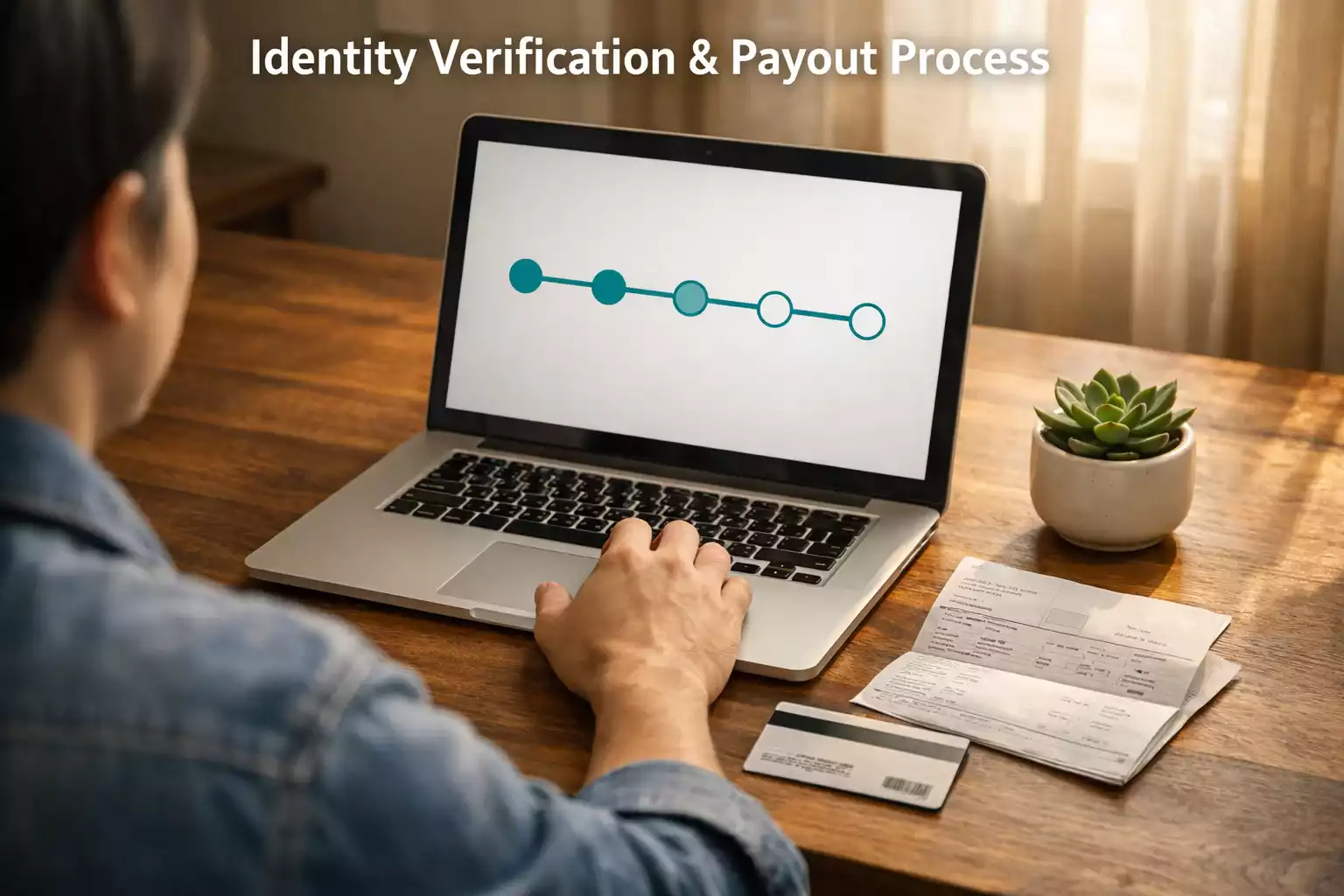
Step 3: Verify Your Identity
KYC (Know Your Customer) verification is mandatory at every legitimate sweepstakes casino before your first redemption. You will need to submit government-issued photo ID (driver's license or passport), proof of address (utility bill or bank statement dated within the last 90 days), and in some cases your Social Security Number or the last four digits of it. Processing times vary: VGW platforms typically complete verification within 24–72 hours, while newer operators may take 5–10 business days. The most common rejection reasons are blurry document scans, address mismatches between your ID and your account, and incomplete submissions. Upload clear, high-resolution images and make sure your registered name matches your ID exactly.
Step 4: Choose Your Payout Method
Available methods vary by platform. The most common options are direct bank transfer (ACH), which typically takes 3–7 business days after KYC approval. Some platforms offer PayPal or Skrill. Stake.us and a few newer operators support cryptocurrency payouts in Bitcoin or Ethereum, which can process significantly faster — sometimes within hours. Gift cards (Amazon, Visa prepaid) are also offered at certain platforms, usually with no additional processing delay beyond KYC. Note that the conversion rate from SC to cash is usually 1:1 at face value, but the payout method itself may carry fees. Bank transfers are typically free; crypto payouts may include network transaction fees.
Step 5: Understand the Effective Value
Here is where the math matters. Operators return 65–70% of Gold Coin purchases as SC prizes, per RG.org analysis. That figure represents the industry-wide average payout rate — the percentage of money flowing into the system (via GC purchases) that eventually flows back out as SC prize redemptions. For free-SC players, this means the coins you accumulate through no-cost methods carry real value, but that value is shaped by the same game mathematics that govern paying players. Your 100 SC is theoretically worth $100, but after wagering, RTP variance, and the statistical house edge, the expected cashout is lower. Going in with realistic expectations — not inflated promises — is the foundation of informed play.
Where It's Legal: US State-by-State Map in 2026
The legal landscape for sweepstakes casinos changed more in 2025 than in the entire preceding decade — and where you live now determines whether the redemption process described above is even available to you. What was once a category that operated freely in nearly every state is now facing a patchwork of outright bans, aggressive enforcement actions, and pending legislation that could further shrink the map. If you are playing — or considering playing — knowing which states still permit access is no longer optional.
States That Banned Sweepstakes Casinos in 2025
Six states passed legislation specifically prohibiting sweepstakes casino operations during 2025, according to an AGA year-end summary: California, Connecticut, Montana, New Jersey, Nevada, and New York. Each ban took a slightly different form, but the collective impact was seismic.
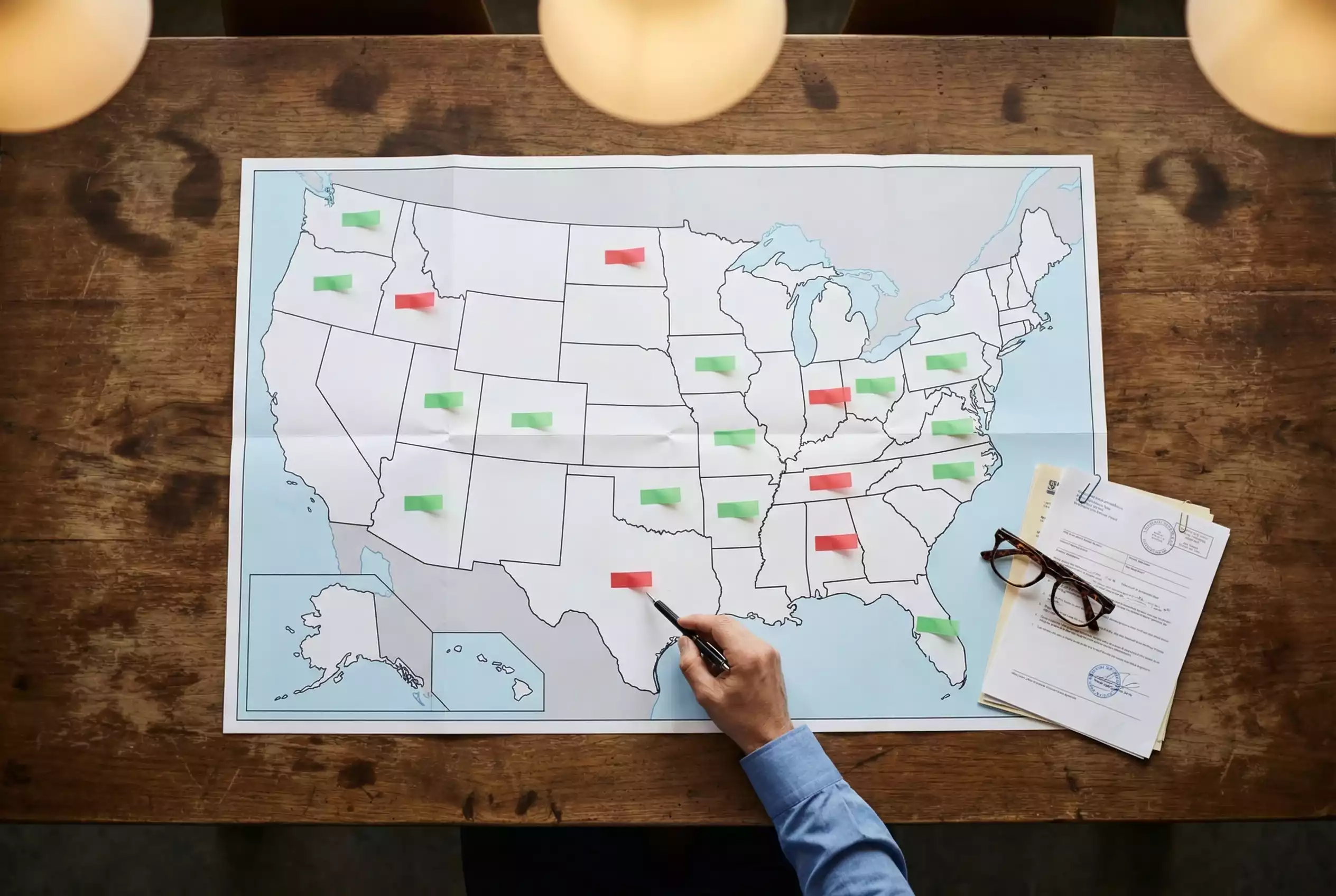
California's AB 831 was the largest single blow. Signed by Governor Newsom on October 11, 2025, and effective January 1, 2026, the law bans the operation of sweepstakes casinos in a state that accounted for an estimated 17.3% of US sweepstakes sales, per Eilers & Krejcik Gaming data. Penalties include fines of up to $25,000 per violation. New York's S5935A followed in December 2025, taking effect immediately upon signing by Governor Hochul. New York's sweepstakes market had generated approximately $762 million in sales in 2024, and the new law imposes fines ranging from $10,000 to $100,000 for violations.
The debate around these bans is far from one-sided. Matt Kaufman, Managing Director of Digital and Interactive Gaming at Eilers & Krejcik Gaming, has argued that sweepstakes casinos do not technically qualify as gambling because they fail to satisfy all three elements of the legal test: prize, chance, and consideration. Because free play and AMOE remove the element of consideration, the legal classification remains contested, as he explained in a SPGA briefing.
Enforcement Beyond Legislation
Bans are only part of the story. Over the course of 2025, more than 100 cease-and-desist letters were sent to sweepstakes operators by states including Arizona, Michigan, and others, according to iGaming Business. These actions do not always result in legislation, but they signal regulatory intent and often cause operators to voluntarily withdraw from those states.
Mississippi went further than most with SB 2510, classifying sweepstakes casino operations as a felony carrying fines of up to $100,000. Indiana's HB 1052, filed in late 2025, specifically targets dual-currency sweepstakes models and, if passed, would criminalize the business model itself.
States Where Sweepstakes Casinos Still Operate
As of early 2026, sweepstakes casinos continue to operate in the majority of US states. Idaho and Washington had pre-existing restrictions that preceded the 2025 wave. The remaining states — including large markets like Texas, Florida, Pennsylvania, Ohio, and Illinois — have not passed specific bans, though enforcement activity varies. Texas, in particular, remains a major market with no current legislation targeting sweepstakes casinos, but the absence of a ban is not the same as an endorsement. Players in any state should verify platform availability directly, as operators may restrict access in states where they perceive legal risk.
The Revenue Fallout
The regulatory crackdown has measurable financial consequences. After California signed AB 831, Eilers & Krejcik Gaming revised its 2025 sweepstakes revenue forecast downward from $4.7 billion to $4.0 billion and projected a further 10% decline in 2026 — the sector's first-ever contraction, as reported by iGaming Business. For players, this means fewer platforms, potentially tighter bonuses, and a market that is consolidating rather than expanding. For the industry, it marks the end of unchecked growth.
Sweepstakes Casinos vs. Real-Money iGaming
From a player's screen, a sweepstakes casino and a regulated online casino can look almost identical. Same slots from the same providers. Same table game interfaces. Same deposit buttons (or, in the sweepstakes case, "purchase" buttons). The differences live beneath the surface — in the legal frameworks, the financial protections, and the revenue numbers that reveal just how different these two models really are.
The scale comparison alone tells a striking story. In 2024, sweepstakes casino gross sales in the US exceeded regulated iGaming revenue for the first time, according to RG.org citing Eilers & Krejcik data. But by 2025, the regulated side pulled ahead decisively. The AGA Commercial Gaming Revenue Tracker shows that US commercial gaming generated a record $78.7 billion in gross gaming revenue in 2025, growing 9.2% year-over-year. Within that, the iGaming segment (legal online casino) reached $10.7 billion, up 27.6%, and generated $2.6 billion in state gaming taxes — a 36.9% increase. Sweepstakes casinos, by contrast, contributed zero dollars in gaming tax.
That tax gap is the single biggest point of contention in the regulatory debate. Legislators see sweepstakes casinos competing with a regulated industry that generates significant public revenue, and they are responding accordingly. Whether state estimates of lost tax revenue are precisely accurate or inflated for political effect, the underlying concern is real: a multi-billion-dollar sector operates with zero contribution to state coffers.
For players, the practical differences extend beyond politics. Regulated iGaming casinos are subject to state gaming commission oversight. This means mandatory RNG (random number generator) audits, published payout rates, enforced self-exclusion databases, deposit limits backed by regulation, and dispute resolution processes with real teeth. Sweepstakes casinos offer some of these protections voluntarily, but compliance is self-regulated, and no state agency monitors adherence.
Payout mechanics differ as well. Regulated online casinos process withdrawals as standard banking transactions, with direct deposit, PayPal, or check options and timelines governed by state regulations. Sweepstakes casinos process "prize redemptions," which are subject to their own internal policies. Wagering requirements at sweepstakes casinos (typically 1x) are far lower than the 20x–40x common in regulated casino bonus offers, but the redemption process itself — KYC, processing delays, minimum thresholds — introduces friction that regulated casinos manage more smoothly.
The access question matters most for the majority of US players. Regulated iGaming is currently live in fewer than ten states. Sweepstakes casinos, despite the 2025 bans, remain accessible in the majority of states. For a player in Texas, Ohio, or Florida — states with large populations and no legal online casino — sweepstakes platforms are the closest thing to an iGaming experience available without breaking any laws. That accessibility is both the sector's greatest asset and the source of its regulatory conflict.
Strategies to Maximize Your Free SC
Free SC accumulation is a game of small, consistent actions rather than one big score. Players who treat it as a routine — not a gamble — tend to extract the most value. Here are the approaches that hold up under the math.
Stack multiple platforms. There is no rule limiting you to one sweepstakes casino. Registering at three or four platforms multiplies your sign-up bonuses, daily logins, and AMOE opportunities. If each platform yields 3–5 SC per month through free methods, running four accounts pushes you to 12–20 SC monthly — approaching the minimum redemption threshold in a few months rather than many. The time cost is real (multiple logins, separate KYC processes), but for players committed to the free-play path, this is the single most effective multiplier.
Prioritize daily logins over sporadic play. Streak-based login systems reward consistency. Missing one day on a seven-day streak bonus resets the multiplier, which means the difference between logging in six days and seven days can be more than 1 SC. Set a reminder or build it into your morning routine. The players who extract the most free SC treat daily logins the way frequent flyers treat mileage runs — not exciting, but the compound returns are real.
Play high-RTP games when wagering SC. When you do accumulate free SC and begin wagering them toward the playthrough requirement, game selection matters. A slot with 97% RTP will, over time, return $97 for every $100 wagered. A slot with 92% RTP returns $92. On a 1x wagering requirement for 100 SC, that five-point RTP difference means keeping roughly 5 SC more. Not every sweepstakes casino publishes individual game RTPs, but platforms that use well-known providers (Pragmatic Play, NetEnt, etc.) typically offer games with established and verifiable payout rates.
Track AMOE limits and response times. Each platform sets its own AMOE rules — how many mail-in requests per day or week, how much SC per request, and how long processing takes. Keeping a simple log (platform, date sent, date credited, amount received) lets you identify which platforms honor requests fastest and most consistently. Some players report that certain casinos process AMOE within a week, while others take the full 14 business days. Optimize for the responsive ones.
Monitor social media contests, but be selective. Not all social giveaways are worth your time. Focus on platforms that run frequent, low-barrier contests (like, comment, share) with guaranteed SC payouts rather than large-pot raffles where your odds are slim. A daily contest awarding 1 SC to 20 winners from 200 entries is better value than a monthly raffle awarding 50 SC to one winner from 10,000 entries — even though the headline number looks smaller.
Responsible Play at Sweepstakes Casinos
The sweepstakes model was built on the premise that this is not gambling. The legal argument has merit — there is a free method of entry, no purchase is required, and the outcome involves promotional prizes rather than traditional wagers. But the behavioral reality is more complicated, and the data makes that clear.
Research from the American Gaming Association found that 68% of sweepstakes casino players identify winning money as their primary motivation. Not entertainment. Not passing time. Money. That figure aligns with what critics have argued for years: regardless of the legal label, the psychological experience of playing SC games is functionally identical to gambling. The dopamine loop of spinning, winning, losing, and chasing is the same whether the currency is called Sweeps Coins or US dollars.
Tres York, VP of Government Relations at the AGA, put it plainly in response to the organization's consumer survey: consumers see through the "sweepstakes casino" label and recognize these platforms for what they functionally are — gambling, as stated in AGA's research release.
This creates a responsibility gap. Regulated online casinos in states like New Jersey, Pennsylvania, and Michigan are required by state gaming commissions to offer self-exclusion programs, deposit and loss limits, cool-off periods, and links to problem gambling resources. These are not optional — they are conditions of licensure. Sweepstakes casinos face no equivalent requirement. Some platforms offer voluntary tools — spending limits, session time reminders, self-exclusion options — but adoption and enforcement vary widely, and no external body verifies compliance.
The SPGA's Code of Conduct, introduced in late 2024, represents the industry's attempt at self-regulation. It covers age verification, advertising standards, and responsible gaming practices. Member operators that sign on commit to meeting these standards, but the SPGA has limited enforcement power compared to a state gaming commission. For players, the practical implication is straightforward: the safeguards exist at some platforms but not all, and their effectiveness depends on operator commitment rather than regulatory mandate.
If you play sweepstakes casinos — whether for free or through GC purchases — a few principles apply regardless of which platform you use. Set a time limit before you start a session and stick to it. If you purchase GC packages, set a monthly budget and treat it as entertainment spending, not investment. Track your SC redemptions against your GC purchases; if the numbers are moving in the wrong direction over time, that is a signal worth paying attention to. And if you feel that your play has become compulsive or is affecting your finances, relationships, or wellbeing, the National Council on Problem Gambling helpline (1-800-522-4700) provides free, confidential support 24/7.
Frequently Asked Questions About Free SC
What Are Sweeps Coins and How Are They Different From Gold Coins?
Sweeps Coins (SC) and Gold Coins (GC) are the two currencies used at every sweepstakes casino, and they serve fundamentally different purposes. Gold Coins are the entertainment currency — you receive them for free and can buy them in packages, but they can never be redeemed for cash or prizes. They exist purely for recreational play. Sweeps Coins, on the other hand, are the redeemable currency. SC cannot be purchased directly; they are distributed for free through sign-up bonuses, daily logins, social media giveaways, mail-in AMOE requests, and as bonus inclusions with GC purchases. Once you accumulate enough SC (typically 50–100 depending on the platform) and complete identity verification, you can redeem them for real cash prizes at a standard conversion rate of 1 SC = $1. The distinction matters legally because the free availability of SC is what allows sweepstakes casinos to classify their operations as promotional sweepstakes rather than gambling.
How Can I Get Free SC Without Buying Anything?
There are five established methods for acquiring Sweeps Coins at zero cost. First, no-deposit sign-up bonuses: most major sweepstakes casinos award 1–10 free SC when you create an account. Second, daily login rewards: platforms typically credit 0.10–1.00 SC per day, with streak bonuses for consecutive logins. Third, social media giveaways: operators run contests on Facebook, X, Instagram, and TikTok where players can win SC by engaging with posts. Fourth, referral programs: inviting friends who register and meet activity thresholds can earn you 5–10 SC per referral at many platforms. Fifth, mail-in AMOE (Alternative Method of Entry): every legitimate sweepstakes casino is legally required to accept handwritten postal requests for free SC, typically awarding 2–5 SC per request. Stacking these methods across multiple platforms is the most effective approach to accumulating free SC over time.
Which US States Have Banned Sweepstakes Casinos as of 2026?
As of early 2026, six states passed specific legislation banning sweepstakes casinos during 2025: California (AB 831, effective January 1, 2026), New York (S5935A, effective immediately upon signing in December 2025), Connecticut, Montana, New Jersey, and Nevada. Idaho and Washington had pre-existing restrictions that predate the 2025 legislative wave. Additionally, more than 100 cease-and-desist letters were sent to sweepstakes operators by states including Arizona and Michigan during 2025, and bills are pending in states like Indiana (HB 1052) and Mississippi (SB 2510). The majority of US states still permit sweepstakes casino access, but the regulatory environment is shifting rapidly. Players should verify platform availability in their state directly, as operators may restrict access even in states without formal bans.
Methodology: How We Evaluated Casinos
Every platform discussed in this guide was assessed against a consistent set of criteria, weighted to reflect what matters most to players who prioritize free SC and transparent redemption over promotional noise.
Free SC generosity covers sign-up bonuses, daily login rewards, AMOE acceptance, social media giveaway frequency, and referral programs. We measured the total SC a free player can realistically accumulate in the first 30 days using only no-cost methods. Game library depth accounts for the number of available titles, provider variety, and the presence of games with published or verifiable RTP data. Redemption transparency evaluates minimum thresholds, wagering requirements, stated payout timelines, and actual player-reported processing times. KYC and payout reliability draws on documented experiences across player forums, review platforms, and our own verification testing. Regulatory track record considers whether the operator has faced legal actions, cease-and-desist orders, or state-level bans, and how it has responded to those challenges.
Data sources include public financial filings, SEC documents (such as the DoubleDown Interactive 6-K), industry reports from Eilers & Krejcik Gaming and KPMG, regulatory documents from state legislatures, and research from organizations including the American Gaming Association and RG.org. Player-reported data is used directionally — it informs assessments but does not override verified sources. We do not accept payment from operators for inclusion or ranking position. Where information is uncertain or contested, we note the limitation rather than present a false confidence.