
Introduction: The Tax Question Nobody Asks Until Redemption
Most sweepstakes casino players don’t think about taxes until the first time they redeem SC for cash — and by then, the taxable events have already occurred. The confusion is understandable. These platforms market themselves as free-to-play social casinos, and the idea that “free” virtual coins could generate a tax bill feels counterintuitive. But the IRS doesn’t care about marketing labels. It cares about whether you received something of value, and redeemed sweeps coins are unambiguously that.
The tax dimension of sweepstakes casinos is part of a larger tension between the industry and regulators. The American Gaming Association has estimated that unregulated operators, including sweepstakes casinos, account for roughly $17.3 billion in potential tax revenue that never reaches state or federal coffers, according to reporting on AGA’s position. That figure reflects the industry-level gap, but the player-level question is simpler: do you owe taxes on sweepstakes casino winnings, and if so, how much? The answer is yes, and the details matter more than you’d expect.
IRS Classification of SC Prizes
The IRS treats sweepstakes winnings as taxable income under Section 74 of the Internal Revenue Code. This applies to prizes from traditional sweepstakes, contests, game shows, and — yes — sweepstakes casinos. When you redeem SC for cash, the dollar amount you receive is considered ordinary income, taxable at your applicable federal income tax rate. State income taxes may also apply, depending on where you live.
The classification doesn’t depend on whether the sweepstakes casino calls itself a “social casino” or a “promotional gaming platform.” What matters to the IRS is the economic substance: you received money. The fact that the money originated as virtual sweeps coins earned through a dual-currency model is irrelevant to the tax treatment. Redeemed SC equals income, period.
The scale of tax exposure at the operator level provides useful context. VGW, the company behind Chumba Casino and LuckyLand Slots, reported paying $121 million in taxes for the FY2023-24 fiscal year, according to SBC Americas reporting on VGW’s ASIC annual report. That figure reflects corporate tax obligations, not player-level taxes, but it demonstrates that the revenue flowing through these platforms is large enough to generate nine-figure tax bills. On the player side, the individual amounts are obviously much smaller — but the legal obligation exists at every dollar of redemption.
One subtlety: SC that you earn but don’t redeem are not taxable. Your unredeemed SC balance sitting in a sweepstakes casino account has no tax consequence until you convert it to cash. The taxable event is redemption, not acquisition. This means you can accumulate SC over months or years without triggering any tax obligation — the clock starts only when the money hits your bank account or crypto wallet.
Reporting Thresholds and 1099 Forms
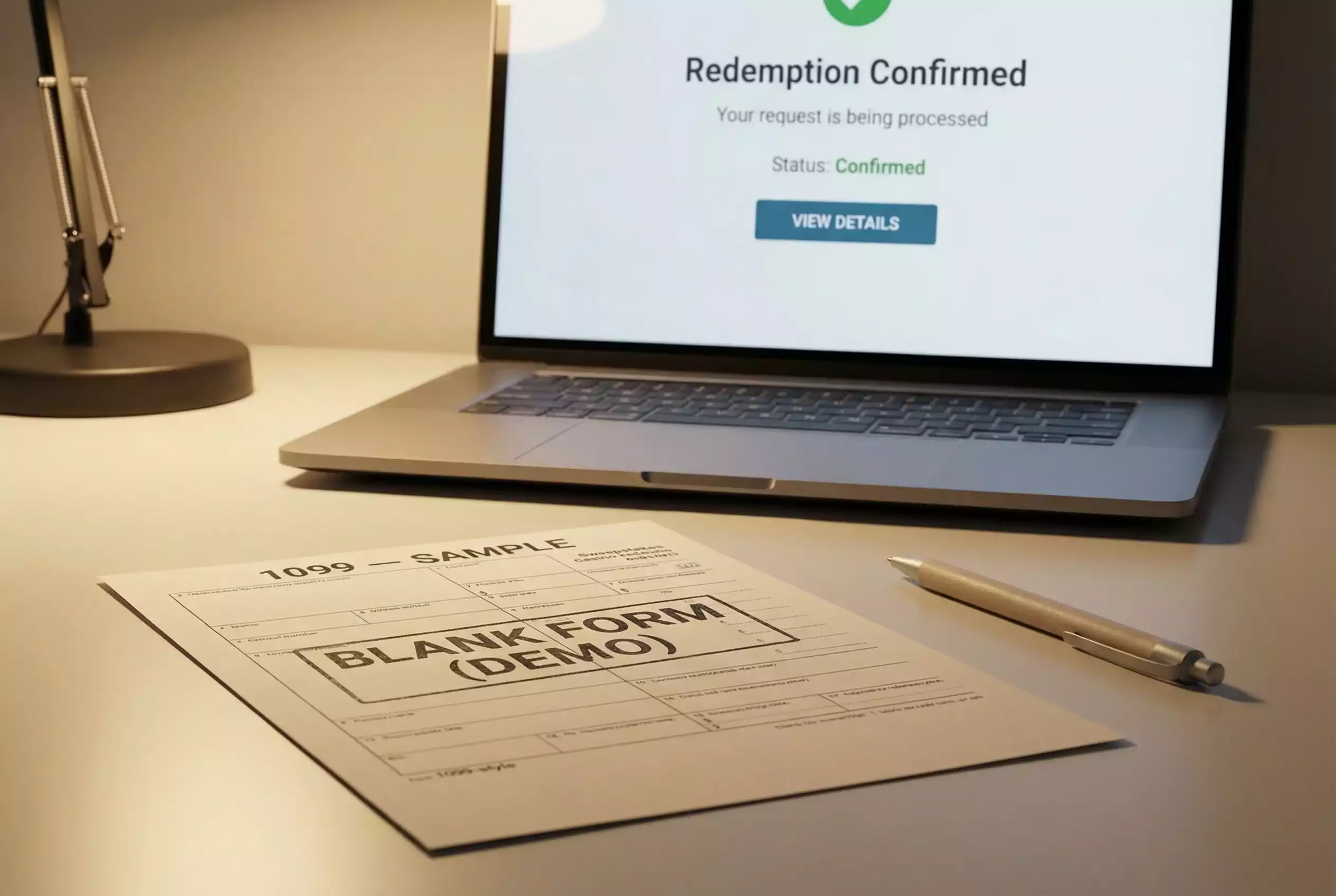
The $600 threshold is the number most players need to know. Under current IRS rules, any entity distributing prizes of $600 or more to a single recipient in a calendar year is required to report the payout on a 1099-MISC form. The casino sends a copy to you and a copy to the IRS. If your total SC redemptions at a single platform exceed $600 in a year, expect a 1099 in your mailbox or email by January 31 of the following year.
Below $600, the reporting obligation shifts. The casino isn’t required to issue a 1099 for smaller total payouts, but — and this is the part most players miss — you’re still legally required to report the income on your tax return. The IRS doesn’t exempt income just because it falls below the 1099 threshold. The threshold only determines whether the payer has a reporting obligation. Your obligation to report all taxable income exists regardless of the amount.
In practice, many players who redeem small amounts of SC — $50 here, $100 there — don’t report the income and never hear from the IRS. Whether that’s because the amounts are immaterial to their overall tax picture or because enforcement on sub-$600 sweepstakes income is effectively nonexistent is an open question. This is not tax advice, and the legal requirement is clear: all sweepstakes income is reportable. The gap between legal obligation and practical enforcement is something each player navigates on their own.
Multi-platform play creates an additional complexity. If you redeem $400 at Chumba and $300 at Pulsz, neither platform reaches the $600 threshold for 1099 reporting. But your combined sweepstakes income is $700, which exceeds the threshold you’d report on your own return. Tracking cross-platform redemptions is your responsibility — no centralized system aggregates sweepstakes payouts across different casinos.
Deductions: Can You Offset Losses?
This is where the tax treatment of sweepstakes casino winnings diverges from traditional gambling income in a way that disadvantages players. Under current tax law — as amended by the One Big Beautiful Bill Act signed in July 2025 — gambling losses can be deducted against gambling winnings, but only up to 90 percent of those losses, and only if you itemize deductions on Schedule A and can substantiate the losses with records. The question for sweepstakes players is whether their GC purchases and SC gameplay losses qualify as deductible gambling losses at all.
The IRS has not issued specific guidance on sweepstakes casino loss deductions, and this is an area of genuine ambiguity. If the IRS classifies your sweepstakes activity as gambling, your GC purchases (which fund your SC play) could potentially be deductible against your SC redemption income. If the IRS treats SC prizes as sweepstakes winnings rather than gambling winnings, the loss deduction may not apply — because sweepstakes prizes are generally classified as “other income” rather than gambling income, and the gambling loss deduction is specific to gambling activity.
The practical implication for most players: don’t assume you can offset SC redemptions against GC purchases without professional guidance. A tax advisor familiar with gaming income can assess whether your specific activity pattern qualifies for loss deductions under current IRS interpretation. The cost of a consultation is modest relative to the potential tax savings — or the potential penalties for claiming deductions that don’t hold up under scrutiny.
One clear rule: you can never deduct more than 90 percent of your losses, and never more than your total winnings. If you redeemed $500 in SC and spent $800 on GC packages, the maximum potential deduction (if gambling loss treatment applies) is $450 — 90 percent of $500 in losses, capped at the $500 winnings amount. The remaining GC spending is a non-deductible personal expense.
Record-Keeping for SC Players
Whether or not you end up owing taxes on your SC redemptions, maintaining records protects you in any scenario — including the one where the IRS comes asking questions three years from now.
Track every redemption: date, platform, SC amount, dollar amount received, and payout method (bank transfer, PayPal, crypto). Most sweepstakes casinos provide a transaction history in your account settings, but don’t rely on it exclusively. Platforms can change, close, or lose data. Export or screenshot your redemption history periodically and store it somewhere you control.
Track GC purchases with the same discipline: date, platform, package purchased, dollar amount, and SC bonus received. Your bank or credit card statements provide a backup record of purchase amounts, but they won’t show the SC component. Only the casino’s purchase history or your own notes capture that detail, and the SC amount is essential if you ever attempt to claim loss deductions.
If you redeem through cryptocurrency, the record-keeping requirements multiply. Track the date of SC-to-crypto conversion, the dollar value at conversion, the crypto amount received, the date of any subsequent sale or exchange, and the dollar value at sale. Each of these data points feeds a different line on your tax return, and missing any of them creates gaps that are expensive to reconstruct after the fact.
A simple spreadsheet — one tab per platform, updated after each transaction — is enough for most players. The ten minutes per month this takes is a negligible investment compared to the cost of reconstructing a year’s worth of transactions during tax season or, worse, during an audit.