Introduction: Two Kinds of “Gray Market”
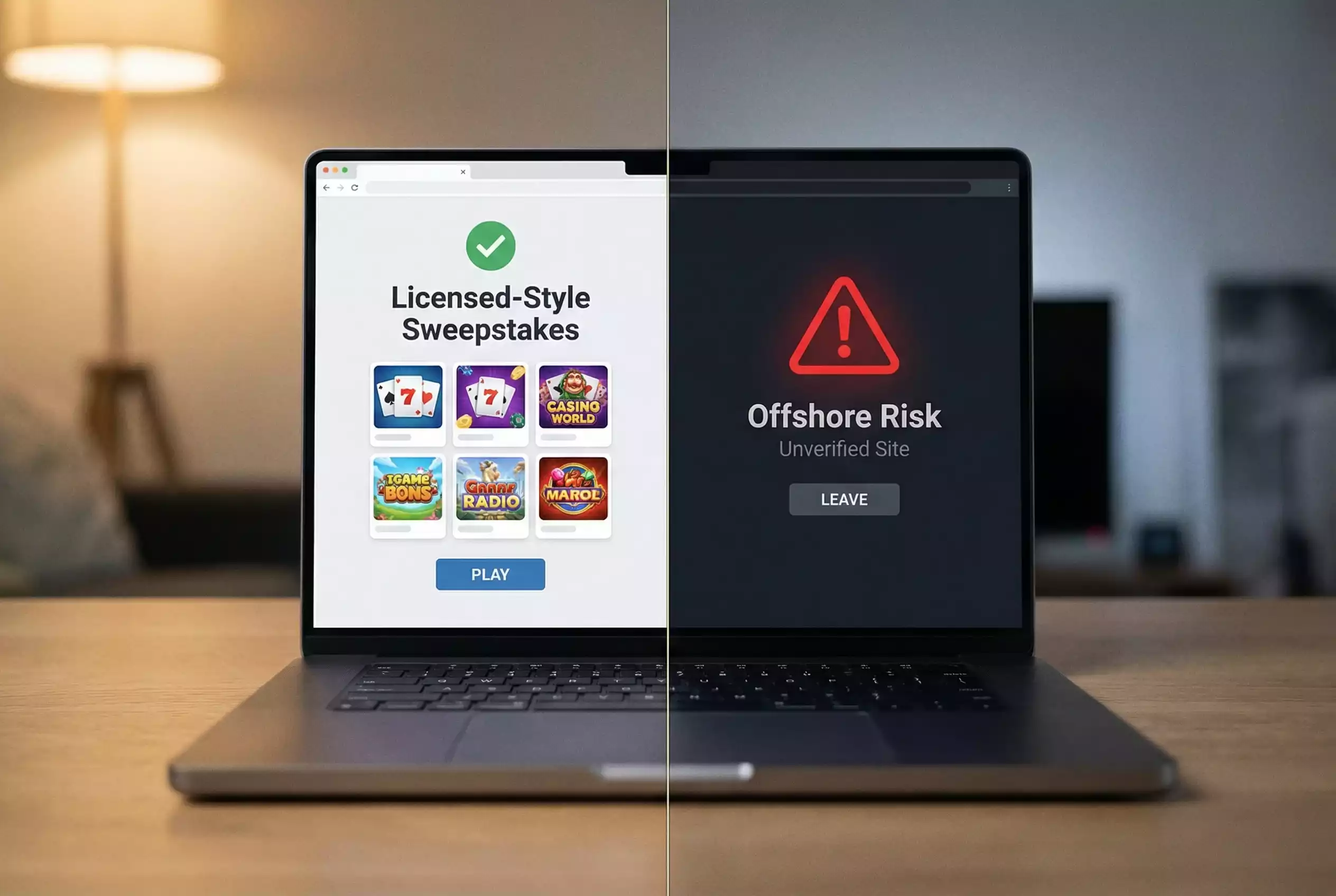
Sweepstakes casinos and offshore gambling sites both serve US players outside the regulated iGaming framework, and from a distance they can look similar — online platforms offering casino-style games with the possibility of real-money outcomes. The differences between them, however, are substantial enough to matter for your money, your data, and your legal exposure. Bill Miller, President and CEO of the American Gaming Association, has characterized both categories as part of a broader ecosystem of unregulated operators using what he called legal acrobatics to sidestep state gambling regulations — operators that, by the AGA’s estimate, cost the US roughly $17.3 billion in potential gaming revenue.
That criticism aside, sweepstakes casinos and offshore sites occupy different legal territories, carry different risk profiles, and operate under different business models. Treating them as interchangeable is a mistake that could cost you in ways that go beyond losing a few dollars at the virtual blackjack table.
Sweepstakes Casinos vs. Offshore Gambling Sites — More on this topic at social casino free sc.
Legal Framework: How Each Category Is Classified
Sweepstakes casinos operate under the promotional sweepstakes exemption that exists in most US states. The dual-currency model — buy gold coins, receive sweeps coins as a free bonus, or obtain SC through no-purchase methods like AMOE — is designed to remove the “consideration” element from the legal definition of gambling. This framework allows most sweepstakes casinos to operate legally in the majority of US states, with the exceptions being states that have passed explicit bans or where attorneys general have issued cease-and-desist orders.
Offshore gambling sites make no attempt at sweepstakes compliance. They’re traditional online casinos — real-money deposits, real-money wagers, real-money withdrawals — operated by companies headquartered in jurisdictions like Curacao, Costa Rica, Antigua, or the Isle of Man. These sites accept US players in violation of the Unlawful Internet Gambling Enforcement Act (UIGEA) of 2006 and state-level gambling prohibitions. Their legal status in the US is unambiguous: they’re illegal for US players to patronize, and illegal for the operators to serve US customers.
The practical enforcement gap is what keeps offshore sites accessible. The US government has successfully prosecuted some offshore operators — PokerStars’ parent company paid $731 million to settle federal charges in 2012 — but the vast majority operate beyond the reach of US law enforcement. Domain seizures, payment processor blocks, and ISP restrictions have disrupted individual operators without eliminating the category. Offshore gambling persists because enforcement is expensive, jurisdiction is fragmented, and new sites replace shut-down ones faster than regulators can act.
The AGA’s estimate of $17.3 billion in potential revenue lost to unregulated operators, as reported by Sweepsy, encompasses both sweepstakes casinos and offshore sites. From the regulated industry’s perspective, both categories drain revenue from the tax-paying iGaming ecosystem. From a legal perspective, however, the two sit on opposite sides of a significant line: sweepstakes casinos claim — and in most states maintain — a legal basis for their operations. Offshore sites don’t.
Player Protections (or Lack Thereof)
The player protection gap between sweepstakes casinos and offshore sites is meaningful, though neither category matches what regulated iGaming provides.
Sweepstakes casinos, particularly those affiliated with the SPGA or operated by companies with established corporate structures, typically offer some baseline protections: KYC verification for redemptions, customer support channels, published terms of service, and responsible gaming tools like spending limits and cooling-off periods. These protections exist voluntarily, not because a regulator mandates them, but they’re present at the major platforms and functional enough to provide recourse when issues arise.
Offshore gambling sites operate with minimal accountability to US players. There is no KYC framework governed by US financial regulations — some offshore sites perform identity checks under their licensing jurisdiction’s rules, others don’t bother. Customer support ranges from responsive to nonexistent. Terms of service may be written in ways that explicitly disclaim liability to players in jurisdictions where the site isn’t licensed to operate — which includes the entire United States. If an offshore site refuses to pay a withdrawal, your recourse options are essentially limited to filing a complaint with the site’s licensing authority in Curacao or wherever it’s registered, a process that rarely produces results for individual players.
The responsible gaming dimension is starkly different. Sweepstakes casinos at least nominally acknowledge the issue and provide tools. Offshore sites rarely offer spending limits, self-exclusion, or cooling-off periods. The player is entirely self-reliant, with no institutional support if play becomes problematic.
Financial Risk: Deposits, Withdrawals, Seizures
The financial risk profile diverges sharply between the two categories, and the differences matter most at the moment you try to get your money out.
At sweepstakes casinos, you don’t deposit money in the traditional sense — you buy gold coin packages, and the SC bonus is the value-bearing component. Redemptions are processed through US financial infrastructure: bank transfers, PayPal, and in some cases cryptocurrency. Because the transactions flow through US payment processors and banks, they’re subject to the same consumer protection frameworks that govern any financial transaction. If a sweepstakes casino charges your card for a purchase you didn’t authorize, your bank’s chargeback process provides recourse.
At offshore sites, deposits typically flow through intermediary payment processors designed to circumvent US banking restrictions on gambling transactions. Credit card deposits may be coded as non-gambling purchases to avoid automatic declines. Cryptocurrency is increasingly the primary funding method. Withdrawals pass through the same intermediary channels in reverse, adding processing time and creating points of failure. If an offshore site refuses to process a withdrawal, the intermediary processors are unlikely to intervene on your behalf — they’re facilitating the illegal transaction, not protecting you from it.
Account seizure and fund forfeiture are risks unique to offshore gambling. US authorities have the legal authority to seize funds associated with illegal gambling activity, and offshore site accounts connected to US players are theoretically subject to that authority. While individual account seizures from offshore gambling are rare, they’re not hypothetical — federal enforcement actions have frozen player funds at offshore poker sites in the past, most notably during the 2011 Black Friday shutdown of Full Tilt Poker and PokerStars.
Why Regulators Treat Them Differently
Regulators distinguish between sweepstakes casinos and offshore sites because the legal basis for action differs. Sweepstakes casinos operating the dual-currency model claim a legitimate legal defense — the absence of “consideration” — that requires either new legislation to invalidate (as California and New York have done) or a court ruling to override. Pursuing sweepstakes casinos requires legislative effort, and until 2025, few states had invested that effort.
See also Social Casino Games Online.
Offshore sites, by contrast, are already illegal under existing law. The UIGEA, the Wire Act, and state gambling statutes provide the legal framework for enforcement without any new legislation required. The barrier isn’t legal authority — it’s practical jurisdiction. Operators based in Curacao are beyond the direct reach of US prosecutors, and enforcement action requires international cooperation that’s difficult to coordinate for individual gambling sites.
The result is a regulatory paradox. Sweepstakes casinos, which make at least a colorable legal argument, attract more legislative attention because they can be addressed through domestic legislation. Offshore sites, which are unambiguously illegal, attract less legislative attention because the enforcement challenge is jurisdictional rather than statutory. For US commercial gaming, the regulated industry generated a record $78.7 billion in gross gaming revenue in 2025, according to the AGA Commercial Gaming Revenue Tracker. Both sweepstakes and offshore categories operate outside that regulated ecosystem, but the tools available to bring each category under control are fundamentally different — and neither set of tools has proven fully effective.