Introduction: NY’s Swift Action
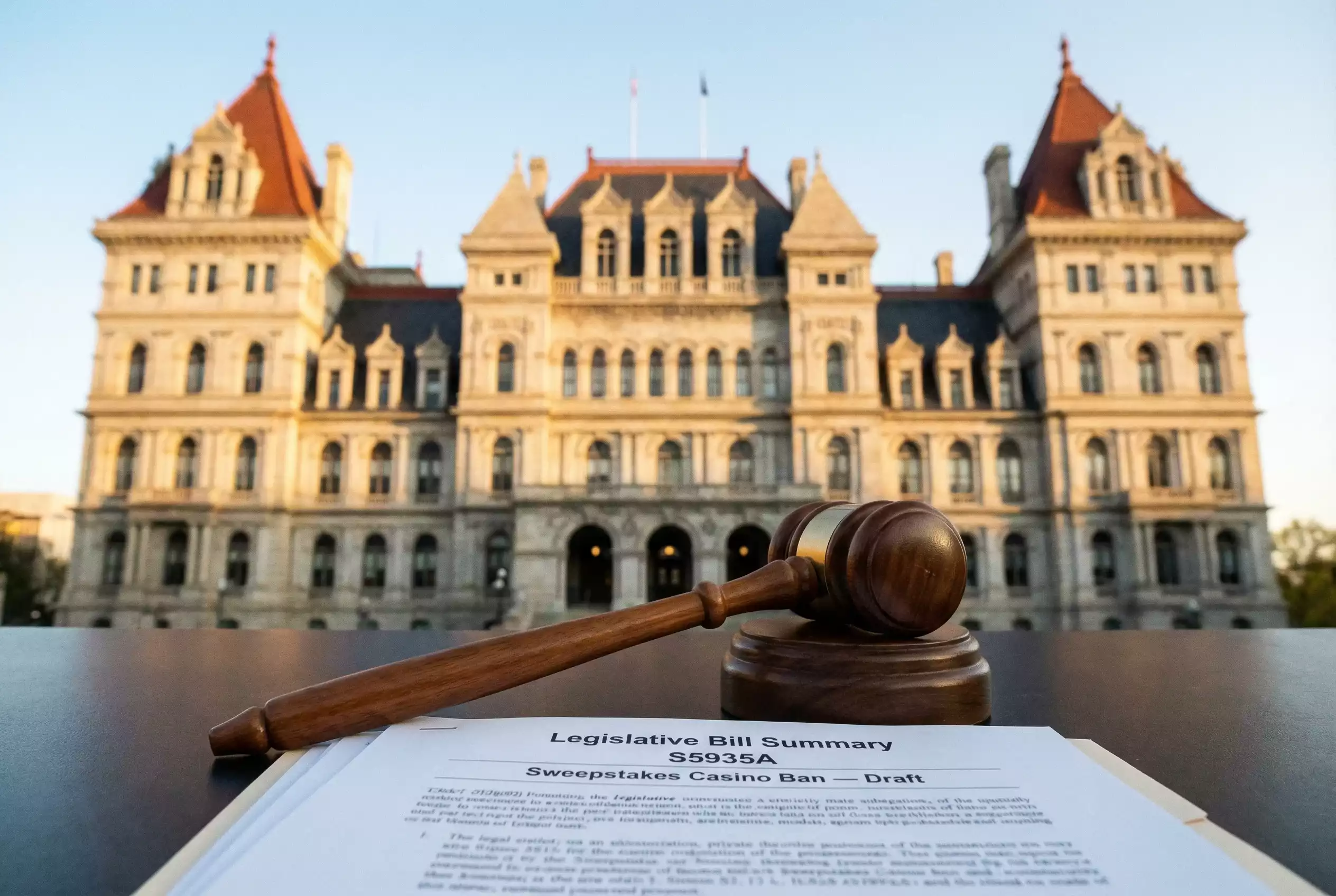
New York didn’t ease into its sweepstakes casino ban — it dropped the hammer overnight. Governor Kathy Hochul signed S5935A into law on December 5, 2025, and unlike California’s AB 831, which included a transition period before the January 1 effective date, New York’s ban took effect immediately upon signing. One day sweepstakes casinos were accessible to New Yorkers; the next day they weren’t. The abruptness caught players and operators alike off guard, creating a scramble to process pending redemptions and suspend accounts before enforcement actions could begin.
The New York ban matters beyond its borders because of what it represents. New York is the fourth-largest state by population, a major media market, and a state with an existing regulated sports betting industry that generates substantial tax revenue. When a state of that profile decides to ban sweepstakes casinos with immediate effect and aggressive penalties, it sends an unambiguous signal to every other state legislature watching from the sidelines.
S5935A: Fines, Enforcement, and What “Immediate” Means
The full text of S5935A lays out a penalty structure designed to make non-compliance financially devastating. Operators who continue to serve New York residents after the ban face fines ranging from $10,000 to $100,000 per violation. As with California’s AB 831, each day of continued operation constitutes a separate violation, meaning an operator who ignores the ban for a month could face cumulative fines in the millions.
The enforcement mechanism runs through the New York Attorney General’s office and the state’s existing consumer protection apparatus. The law gives prosecutors the authority to pursue both civil and criminal penalties against operators, their executives, and their US-based business partners. The inclusion of business partners is notable — it extends liability to payment processors, advertising platforms, and affiliate marketers who facilitate the operation of banned sweepstakes platforms within New York.
The “immediate” effective date was the bill’s most unusual feature. Most legislation includes an implementation window — a period between signing and enforcement that allows affected parties to adjust. S5935A offered none. The law became enforceable the moment Hochul signed it, which meant that operators had zero days to wind down California-style. The practical result was chaotic: some platforms blocked New York IP addresses within hours, while others took days or weeks to fully comply, leaving a gray period during which enforcement risk was theoretically live but practically uncertain.
The prior sweepstakes market in New York was substantial. EKG estimated that sweepstakes casino sales in New York reached approximately $762 million in 2024 — making it one of the top five state markets by revenue. The immediate elimination of that revenue stream, without the phased transition that California provided, amplified the financial shock for operators with significant New York exposure.
NY’s $762 Million Sweepstakes Market — Before and After
Before the ban, New York’s sweepstakes casino market was thriving. The state’s large urban population, high smartphone penetration, and limited regulated online casino options (New York has legal online sports betting but not online casino games) created ideal conditions for sweepstakes platforms. Players who wanted casino-style gameplay but lacked access to regulated iGaming turned to sweepstakes casinos as the next best option — and hundreds of millions of dollars flowed through those platforms annually.
New York’s ban was part of a broader wave. According to Yogonet’s year-end summary citing AGA data, six states passed legislative bans on sweepstakes casinos in 2025: California, Connecticut, Montana, New Jersey, Nevada, and New York. The combined market impact of these bans was substantial — together, these states represent a significant share of the US population and an even larger share of sweepstakes spending. New York alone accounted for roughly $762 million of that total.
After the ban, the immediate effect was a full market shutdown within the state. Operators geo-blocked New York residents, suspended active accounts, and ceased all advertising targeting New York audiences. Players with unredeemed SC balances faced varying experiences depending on the platform — some operators processed final redemptions proactively, while others required players to contact support within a limited window. Players who missed that window reported losing access to unredeemed SC, though individual outcomes varied by platform and by the size of the balance involved.
The longer-term effect on operator revenue is still materializing. For VGW, which dominated the national market, losing New York represented a meaningful but absorbable hit. For smaller operators where New York constituted a larger revenue share, the ban accelerated an already difficult financial trajectory defined by mounting regulation and intensifying competition.
Connection to NY iGaming Legalization Efforts
The New York sweepstakes ban doesn’t exist in a vacuum — it’s part of a larger political conversation about legalizing regulated online casino gaming in the state. New York already runs one of the most successful online sports betting markets in the country, generating billions in handle and hundreds of millions in tax revenue since its January 2022 launch. The logical next step, according to many in the gaming industry and state legislature, is extending that regulatory framework to include online casino games.
The sweepstakes ban can be read, in part, as clearing the field for that future legalization. Allowing sweepstakes casinos to operate unregulated while simultaneously developing a regulated iGaming framework would create a contradiction — why would operators apply for expensive licenses and pay high tax rates when they could serve New York players through an unregulated sweepstakes model for free? Banning sweepstakes casinos first removes the low-cost alternative, making regulated iGaming the only legal path to online casino gameplay once it becomes available.
Multiple iGaming bills have been introduced in the New York legislature over the past several sessions, though none had passed as of early 2026. The primary debates revolve around tax rates (New York’s online sports betting tax of 51 percent is the highest in the country), licensing fees, the number of authorized operators, and the role of the state’s existing land-based casino operators in the online market. These are complex negotiations with billions of dollars at stake, and they won’t resolve quickly.
For New York players, the timing gap is the frustration. The state has banned the unregulated option without yet providing the regulated alternative. How long that gap persists depends on the pace of Albany’s legislative process — a pace that historical precedent suggests will be measured in years rather than months.
Options for NY Players
The option set for New York residents mirrors California’s in its limitations. Legitimate sweepstakes casinos that comply with S5935A are no longer accessible, and attempting to circumvent the geo-block through VPN or other means violates both the platform’s terms of service and potentially state law.
Legal online gambling in New York is currently limited to online sports betting, which operates through licensed platforms like FanDuel, DraftKings, and others. These platforms offer no casino-style games — no slots, no table games, no sweepstakes mechanics. For players whose interest centers on sports, the regulated market provides a fully legal and functional alternative. For casino-style players, it’s irrelevant.
Social casino apps that use only non-redeemable currency remain legal. These platforms offer the gameplay experience without the prize redemption component — the same slots, the same table games, but with virtual coins that have no cash value. For players who genuinely enjoy the gaming mechanics and can separate that enjoyment from the monetary motivation, social casinos fill part of the gap.
Land-based casinos in New York — including tribal casinos and the state’s commercial casino properties — are unaffected by S5935A and continue to operate. For players in proximity to a physical casino, the traditional venue remains available. The practical barrier is geography: New York’s casinos are concentrated in specific regions, and for the millions of residents in New York City and its suburbs who played sweepstakes casinos precisely because of their convenience, a two-hour drive to a physical casino is not a comparable substitute.