Introduction: Mississippi Takes the Hardest Swing — and Misses
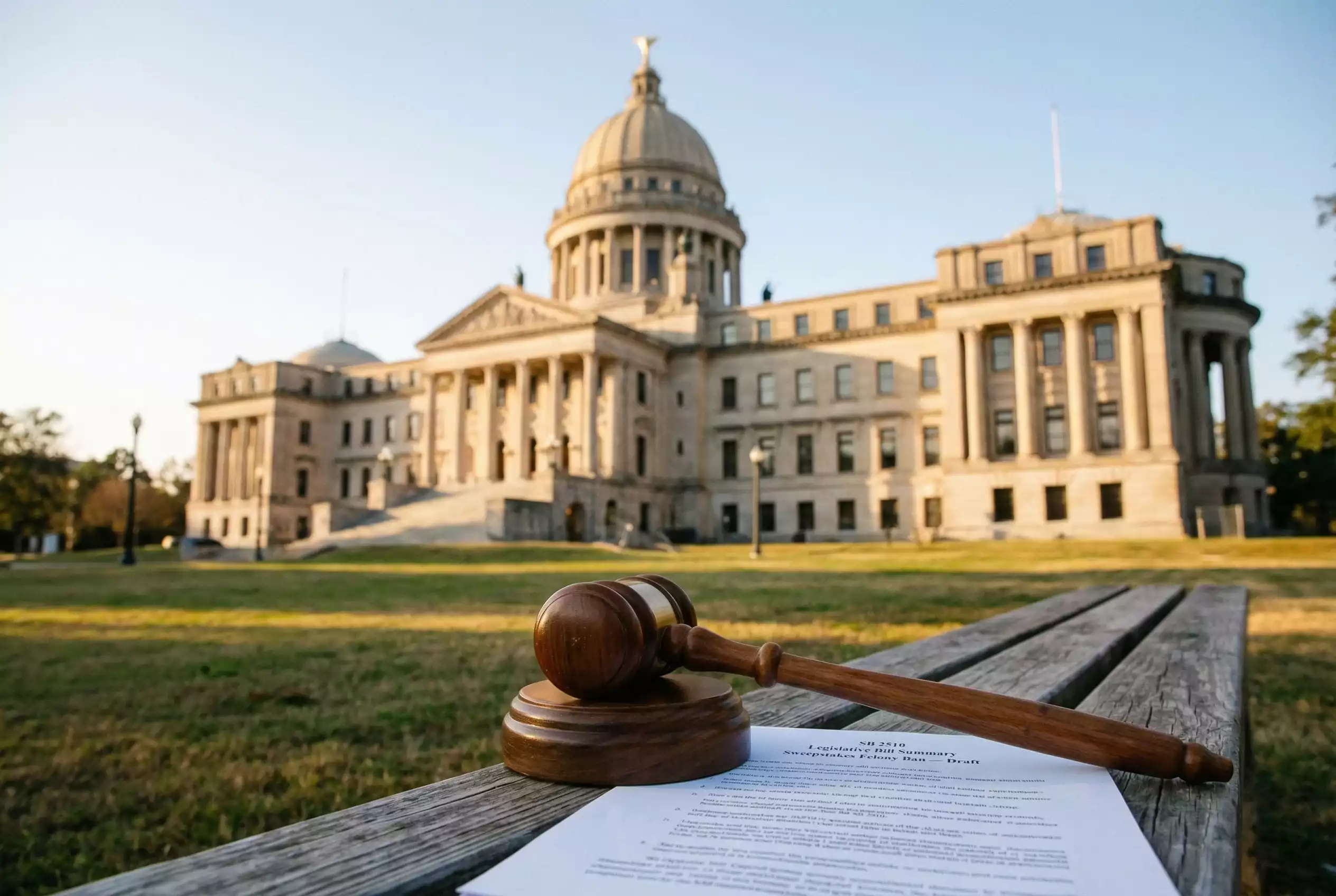
When states started banning sweepstakes casinos in 2025, Mississippi’s Senate led with arguably the most aggressive proposal of any chamber. Senate Bill 2510 proposed classifying sweepstakes casino operations as a felony — with fines up to $100,000 and prison sentences of up to 10 years. The bill passed the Mississippi Senate by a near-unanimous 44–1 vote in February 2025. But SB 2510 never became law: the House amended it to include online sports betting language, the two chambers couldn’t reconcile their differences, and the bill died in conference on March 31, 2025.
Mississippi’s story matters even in failure. The state demonstrated that felony-level penalties for sweepstakes operations are politically achievable in at least one legislative chamber, and the Mississippi Gaming Commission followed through with cease-and-desist enforcement against operators like Chumba Casino in June 2025 — effectively forcing several platforms to exit the state voluntarily. A successor bill, SB 2104, passed the Senate unanimously (52–0) in the 2026 session but again stalled in the House, dying in committee in March 2026. Mississippi’s repeated inability to finalize a ban despite strong Senate support reveals how gaming politics — specifically, disputes over online sports betting — can derail even popular legislation.
Mississippi SB 2510 — More on this topic at social casino free sc.
SB 2510: Proposed Felony Classification and $100K Fines
The core provisions of SB 2510 were direct and uncompromising. According to Lineups.com, the bill proposed classifying the operation of sweepstakes-style gaming platforms as a felony offense, with fines reaching up to $100,000 and prison sentences of up to 10 years per violation. The felony classification was the most severe penalty any state had put forward for sweepstakes operations at the time — escalating violations from the existing misdemeanor level to felony status.
The bill defined the prohibited activity in terms that specifically targeted online sweepstakes casinos, online sports pools, and online racebooks. Any online platform offering games of chance or digital simulations thereof would be classified as a gambling device and prohibited under Mississippi law. The language also introduced the concept of “simulated gambling programs” — covering platforms that predetermine prizes or connect players to cash-equivalent rewards, even when access is bundled with unrelated purchases. Traditional social casino games with only non-redeemable currency were not the primary focus.
The $100,000 fine per violation, combined with felony criminal charges and asset forfeiture provisions, created a penalty structure designed to operate on multiple levels. The financial penalty aimed to exceed the revenue an operator could generate from Mississippi players. The felony classification added personal liability for executives and directors. And the forfeiture provisions authorized the state to seize assets, rights, and privileges connected to violations — potentially clawing back revenue already earned.
The bill’s enforcement provisions authorized both the Attorney General and county prosecutors to bring charges, with the Mississippi Gaming Commission providing technical expertise. Prosecutions could be brought in the county where the violation occurred or in Hinds County (home to the state capital), centralizing legal proceedings near the state’s key institutions.
Why Mississippi Went Further Than Other States
Mississippi’s push for felony penalties reflects the state’s unique relationship with its regulated gaming industry. Mississippi legalized casino gambling in 1990 and has since built a substantial gaming sector centered on the Gulf Coast and the Mississippi River corridor. The state’s commercial casinos generate billions in revenue and employ tens of thousands of workers. They also pay significant gaming taxes that fund state services.
From Mississippi lawmakers’ perspective, sweepstakes casinos represent a direct threat to that ecosystem. Every dollar a Mississippi resident spends on a sweepstakes platform is a dollar that doesn’t flow through the state’s regulated casinos, doesn’t generate gaming tax revenue, and doesn’t support the employment base that depends on the licensed industry. The felony classification wasn’t about philosophical opposition to online gaming — it was about protecting an economic asset that the state has spent three decades building.
The political dynamics reinforced the legislative outcome in the Senate. Mississippi’s casino operators are major employers and political donors in the state, and their lobbying apparatus was well-positioned to support aggressive legislation. Senator Joey Fillingane (R-Columbia), the bill’s author, framed it as essential to ridding the internet in Mississippi of unlicensed gambling websites. The consumer protection argument — that sweepstakes casinos operate without the player safeguards that licensed operators are required to provide — added a second justification that produced near-unanimous Senate support (44–1 in 2025, 52–0 in 2026).
The bill’s ultimate failure came not from opposition to banning sweepstakes, but from unrelated political dynamics. The House amended SB 2510 to include online sports betting legalization — an expansion the Senate opposed. This pairing of a ban with a market expansion created an irreconcilable conflict between the chambers. The same pattern repeated in 2026 with SB 2104, underscoring that Mississippi’s inability to pass a sweepstakes ban is a political problem, not a policy disagreement about whether sweepstakes casinos should be banned.
Enforcement Without Legislation: Cease-and-Desist and Operator Withdrawals
Although SB 2510 failed legislatively, the Mississippi Gaming Commission didn’t wait for a new law. In June 2025, the Commission issued a cease-and-desist letter to Chumba Casino (operated by VGW), and the resulting pressure caused several major sweepstakes operators to geo-block Mississippi or disable Sweeps Coin play for state residents voluntarily. The enforcement action demonstrated that even without a specific sweepstakes ban statute, the state’s existing regulatory apparatus had enough leverage to push operators toward compliance.
The broader enforcement context amplified the message. Across the country, over 100 cease-and-desist letters were sent to sweepstakes operators by state authorities in 2025, according to iGaming Business. Mississippi’s actions contributed to that national wave, and the Senate’s near-unanimous votes in favor of felony penalties in both 2025 and 2026 signaled to operators that the political will for a ban exists — even if the legislative mechanics haven’t cooperated.
For Mississippi players, the practical outcome has been a partial withdrawal of sweepstakes access regardless of the bill’s fate. Multiple platforms — including all VGW-operated sites — pulled their Sweeps Coin options from Mississippi following the Gaming Commission’s enforcement actions. Mississippi’s robust land-based casino infrastructure provides a more accessible alternative than exists in many other states, which softened the impact for players who primarily valued casino-style gameplay rather than the convenience of online access. But without enacted legislation, the enforcement remains discretionary rather than statutory — operators could theoretically return if regulatory pressure eases.
Lessons for Other States
Mississippi’s SB 2510 — and its 2026 successor SB 2104 — offer several lessons for states considering their own sweepstakes casino legislation.
The first lesson is that even strong Senate support doesn’t guarantee enactment. Mississippi’s Senate voted nearly unanimously for sweepstakes bans in back-to-back sessions, yet both bills died because of unrelated political disputes in the House. States pursuing sweepstakes bans need to ensure the legislation moves as a standalone measure rather than becoming entangled with broader gaming expansion debates. Indiana’s successful approach — embedding the ban within a broader administrative bill (HB 1052) that included horse racing and alcohol provisions without controversial gaming expansion — avoided this trap.
See also Sweepstakes Casino Lawsuits.
The second lesson is that regulatory enforcement can substitute for legislation in the short term. Mississippi’s Gaming Commission achieved meaningful operator withdrawals through cease-and-desist actions alone, without enacted legislation. States that lack the political consensus for a formal ban can still reduce sweepstakes activity through existing regulatory authority — though this approach relies on sustained enforcement and lacks the permanence of statutory prohibition.
The precedent effect is the most significant lesson. Mississippi demonstrated that felony-level penalties for sweepstakes operations can pass a legislative chamber with near-unanimous support, establishing a high-water mark that future bills in other states can reference. The proposed penalties — $100,000 fines, 10-year imprisonment, and asset forfeiture — represent the most aggressive framework any state has advanced, even if Mississippi itself hasn’t finalized the law.
For players in states where sweepstakes casinos remain accessible, Mississippi’s example is a reminder that the status quo can change through both legislative and regulatory action. Building large unredeemed SC balances at any platform carries the implicit risk that access could be revoked — either by statute or by cease-and-desist — before you cash out. The players who navigated the California and New York bans with the least disruption were the ones who treated their SC balances as short-term holdings rather than long-term savings — redeeming regularly rather than accumulating indefinitely.