The Regulatory Earthquake of 2025
For years, sweepstakes casinos operated in a legal gray zone that most state legislators either didn’t understand or didn’t prioritize. That changed in 2025. In the span of twelve months, six states passed explicit legislative bans on sweepstakes casinos — California, Connecticut, Montana, New Jersey, Nevada, and New York — transforming the regulatory landscape from permissive ambiguity into a patchwork of outright prohibition and aggressive enforcement.
The 2025 regulatory earthquake wasn’t a single event. It was a cascade. California’s AB 831 — the largest ban by market impact — passed without a single dissenting vote. New York’s S5935A took effect immediately upon the governor’s signature. Meanwhile, state attorneys general in Arizona, Michigan, and elsewhere launched enforcement campaigns that went beyond legislation entirely, issuing cease-and-desist orders to operators who had never been formally banned but were told, in no uncertain terms, to leave.
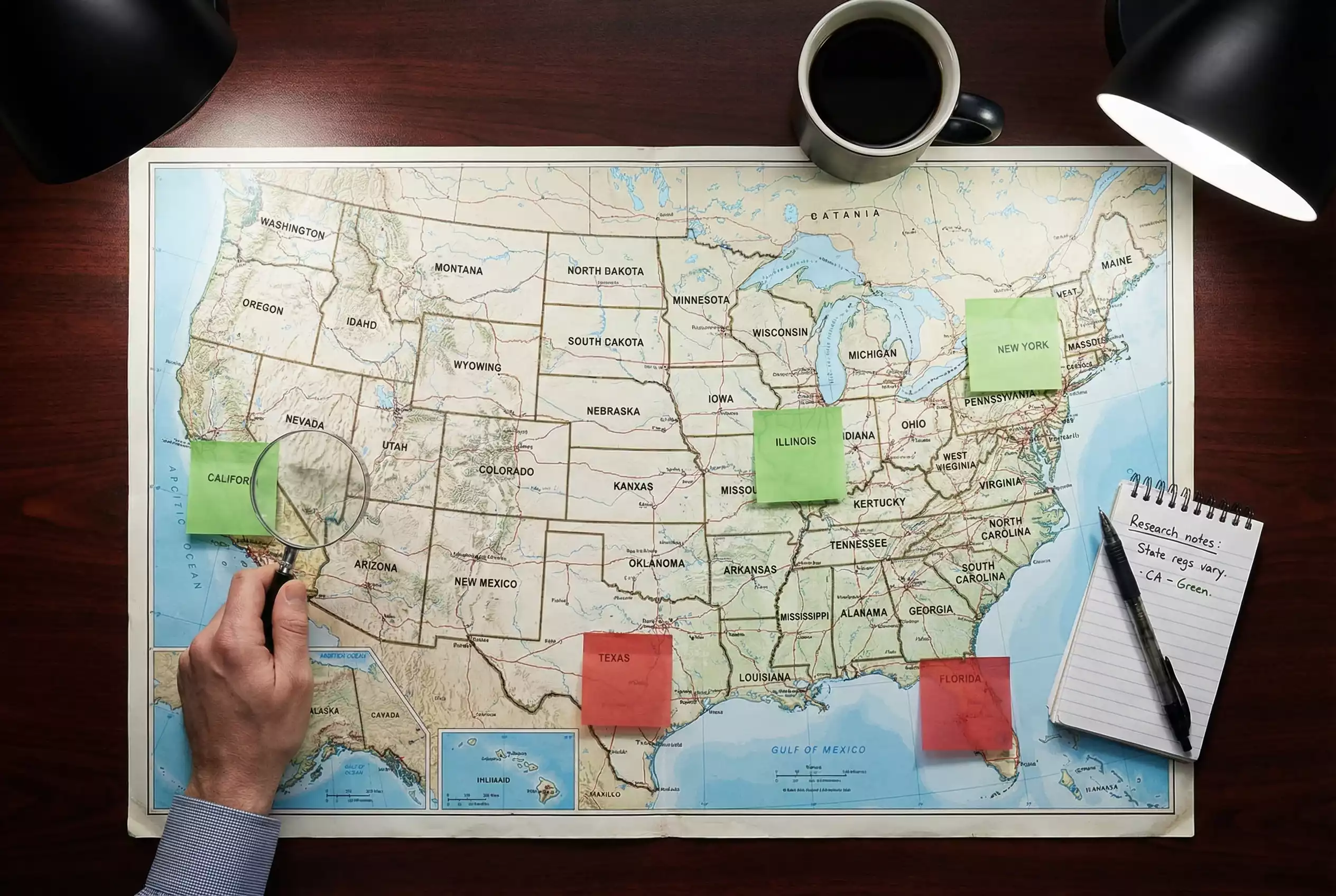
If you’re trying to figure out whether sweepstakes casinos are legal in your state in 2026, the answer is no longer the easy “legal almost everywhere” that dominated the conversation as recently as 2024. The map has fractured. Some states have passed laws with criminal penalties. Others are debating bills that would follow the same path. A handful have taken enforcement action without passing new legislation at all. And the majority still allow sweepstakes casinos to operate, though that majority is shrinking.
This article maps the current legal status of sweepstakes casinos across the United States — state by state, ban by ban, bill by bill. No speculation about where things might be headed based on vibes. Just the legislative record, the enforcement actions, and the revenue data that explains why this is happening now.
States That Banned Sweepstakes Casinos in 2025
Six states enacted legislation in 2025 that explicitly prohibits sweepstakes casino operations within their borders. Each took a slightly different legal approach, but the outcome is the same: operators must cease accepting players from these jurisdictions or face penalties.
California passed AB 831, signed by Governor Newsom on October 11, 2025, effective January 1, 2026. It is the most consequential ban by revenue impact, given California’s population and its outsized share of the sweepstakes market. We cover this in detail in the next section.
New York passed S5935A, signed by Governor Hochul in early December 2025, with immediate effect. New York’s ban carries penalties ranging from $10,000 to $100,000 per violation and targets both operators and payment processors. Its details follow the California breakdown below.
Nevada took what might seem like an ironic step — the state most associated with gambling banned a form of online gaming — but the logic is straightforward. Nevada’s regulated casino industry lobbied aggressively against sweepstakes operators, arguing they siphon revenue from licensed establishments without paying state gaming taxes. The ban passed with bipartisan support.
New Jersey followed a similar rationale. With one of the country’s most mature iGaming markets — legal online casinos have operated in New Jersey since 2013 — legislators viewed sweepstakes casinos as unregulated competitors undermining a tax-generating industry. The ban aligns New Jersey with its existing position of tightly regulating online gaming within state borders.
Connecticut enacted its ban partly at the urging of the Mohegan and Mashantucket Pequot tribes, which operate the state’s two casinos and hold significant political influence over gaming policy. The tribal gaming compacts in Connecticut already restrict online gambling to licensed operators, and sweepstakes casinos were seen as operating outside those agreements.
Montana rounded out the six, passing legislation that classifies sweepstakes casinos as unlicensed gambling operations. Montana’s approach was less about protecting an existing online gaming industry — the state has minimal iGaming infrastructure — and more about the definitional question: legislators determined that sweepstakes casinos, despite the dual-currency model, function as gambling enterprises and should be regulated as such.
What connects all six bans is the underlying argument: sweepstakes casinos operate like online casinos but without the licensing, taxation, or consumer protection requirements that regulated operators must meet. Whether the motivation is protecting state tax revenue, honoring tribal compacts, or enforcing existing gambling definitions, the legislative conclusion has been the same. Ban first, figure out regulation later — if at all.
California AB 831: Anatomy of the Biggest Ban
California’s AB 831 deserves its own section because of what it represents: the largest single-state market loss the sweepstakes industry has ever faced. According to Eilers & Krejcik Gaming’s estimates, California accounted for 17.3% of all sweepstakes casino sales in the United States. When the ban took effect on January 1, 2026, operators lost access to approximately one-sixth of their total addressable market overnight.
The bill passed through both chambers of the California legislature without a single opposing vote. Shawn Fluharty, Delegate from West Virginia and President of the National Council of Legislators from Gaming States, put it bluntly at the NCLGS Winter Conference: the sweepstakes industry couldn’t secure a single favorable vote in California. In a legislature that struggles to reach consensus on nearly anything, the unanimity was remarkable — and telling.
AB 831 defines sweepstakes casinos explicitly and prohibits any operator from offering sweepstakes-style gaming to California residents. The California Senate’s Public Safety Committee analysis laid out the legal reasoning: the dual-currency model, while nominally structured as a promotional sweepstakes, functions as a de facto online casino in its user experience, monetary flows, and player motivation. Violations carry fines of up to $25,000 per infraction.
The sweepstakes industry did not go quietly. Jeff Duncan, Executive Director of the Social Gaming Leadership Alliance, issued an open letter to Governor Newsom arguing that California had always been a leader in innovation, not a state that shuts down opportunities overnight. The SGLA’s position was clear: the industry wanted regulation and was willing to pay taxes. But that argument landed on a legislature already persuaded by the American Gaming Association’s framing and pressure from California’s tribal gaming interests, which viewed sweepstakes casinos as unregulated competition for their own gaming operations.
For players in California, the practical impact was immediate. Major platforms — Chumba Casino, Pulsz, Stake.us, WOW Vegas — geo-blocked California IP addresses starting January 1, 2026. Players with existing accounts and unredeemed SC balances faced a scramble to cash out before the cutoff, with some reporting delays as operators processed a surge of redemption requests in December 2025. Whether those players migrated to VPN-based workarounds is an open question, but operators have been explicit that VPN use violates their terms of service, and accounts caught circumventing geo-blocks are subject to closure and balance forfeiture.
New York S5935A: Immediate Enforcement
New York’s approach to banning sweepstakes casinos differed from California’s in one critical respect: timing. While AB 831 gave operators a roughly three-month window between signing and enforcement, New York’s S5935A took effect the day Governor Hochul signed it on December 5, 2025. No grace period. No wind-down. Operators serving New York players were expected to cease immediately.
The financial stakes in New York were substantial. Industry data pegged the state’s sweepstakes market at approximately $762 million in annual sales during 2024. That’s smaller than California’s share but significant enough that its abrupt removal forced operators to absorb the loss without the gradual adjustment period that a delayed effective date would have allowed.
Senator Joseph P. Addabbo Jr., Chair of the New York Senate Racing, Gaming, and Wagering Committee, framed the ban in terms of protecting both the state’s future iGaming aspirations and vulnerable populations. His stated position: until New York legalizes online gaming through its own regulatory framework, the state does not want an unregulated market expanding, particularly one that might target minors or individuals with gambling problems.
The enforcement teeth in S5935A are sharper than most state-level sweepstakes bans. Penalties range from $10,000 for initial violations to $100,000 for repeat offenses, and the law targets not just operators but also payment processors and affiliates that facilitate transactions with New York residents. That payment processor provision matters — it’s modeled on the approach used in the Unlawful Internet Gambling Enforcement Act at the federal level, creating financial chokepoints that make it difficult for operators to process transactions even if they’re technically based outside the state.
The speed of S5935A’s enforcement caught some players off guard. Unlike California, where the January 1 effective date was widely publicized weeks in advance, New York’s immediate activation meant some players discovered the ban only when they tried to log in on December 6 and found their accounts restricted. Reports of pending redemptions being frozen surfaced in the days after the signing, though most major operators honored existing withdrawal requests that had been submitted before the cutoff.
Cease-and-Desist Wave: AZ, MI, and Beyond
Not every state that moved against sweepstakes casinos in 2025 bothered passing new legislation. Some used existing law and enforcement authority to achieve similar results through a blunter instrument: the cease-and-desist letter.
According to iGaming Business’s year-in-review reporting, more than 100 cease-and-desist letters were sent to sweepstakes operators by state attorneys general and gaming regulators during 2025. Arizona and Michigan were among the most aggressive, with their respective offices of the attorney general issuing formal demands that operators stop serving residents or face enforcement action under existing gambling statutes.
The legal basis for these actions varies by state. In Arizona, the attorney general’s office argued that sweepstakes casinos violate the state’s existing prohibition on unlicensed gambling, regardless of the dual-currency framework. The argument: when a player can purchase Gold Coins, receive Sweeps Coins, play games of chance, and redeem winnings for cash, the transaction functionally constitutes gambling. The promotional sweepstakes label, in this view, is a semantic wrapper around an activity the state already regulates.
Michigan’s approach carried additional weight because the state operates a licensed iGaming market. The Michigan Gaming Control Board took the position that sweepstakes casinos offering cash-redeemable prizes to Michigan residents must hold a Michigan gaming license — which none of them do. The cease-and-desist letters served as formal notice that continued operation without licensing constitutes a violation of state gaming law.
Dan Hartman, Senior Advisor at GMA Consulting and former Director of the Colorado Division of Gaming, captured the regulators’ perspective at the NCLGS Conference in December 2025: companies pay enormous sums for licensing and compliance in regulated states, and allowing sweepstakes operators to bypass that process through a legal loophole undermines the entire regulatory framework. The desire of sweepstakes operators to become regulated, in his view, may have come too late.
The cease-and-desist approach is legally messier than a legislative ban. Operators can — and some have — challenged these letters, arguing that existing gambling statutes don’t apply to promotional sweepstakes models. But challenging a state attorney general in court is expensive, slow, and risks a precedent-setting ruling that could be worse than the cease-and-desist itself. In practice, most operators have quietly geo-blocked the states that issued enforcement actions rather than fighting in court.
Bills in Progress: IN HB 1052, MS SB 2510, and Others
The six states that banned sweepstakes casinos in 2025 are unlikely to be the last. As of early 2026, multiple states have bills in various stages of the legislative process that would impose additional restrictions, bans, or regulatory frameworks on sweepstakes operations.
Indiana’s HB 1052, introduced in December 2025, would criminalize the operation of dual-currency sweepstakes casinos within the state. The bill specifically targets the mechanism that defines the industry — offering a virtual currency that can be redeemed for real prizes through a parallel sweepstakes entry — and classifies it as unlicensed gambling. Indiana’s existing gaming market, dominated by commercial casinos and a growing sports betting sector, has lobbied for the bill as a competitive protection measure.
Mississippi’s SB 2510 goes further than most pending legislation. The bill classifies sweepstakes casino operations as a felony offense, with fines up to $100,000 for operators found in violation. Mississippi’s approach reflects the state’s historically strict stance on gambling outside its regulated casino corridor along the Gulf Coast and the Mississippi River. The felony classification is notably aggressive compared to other states, most of which treat sweepstakes violations as civil or misdemeanor offenses.
Beyond Indiana and Mississippi, several other states have introduced or are preparing legislation that addresses sweepstakes casinos directly or through broader gambling reform packages. Louisiana, which vetoed a sweepstakes ban in 2024 but subsequently saw the Louisiana Gaming Control Board take enforcement action against specific operators, represents a state where the legislative and regulatory paths are running in parallel. Ohio and Pennsylvania — both states with robust regulated iGaming markets — have seen legislative discussion around sweepstakes regulation, though neither has advanced a bill to committee as of this writing.
The pattern across these pending bills is consistent: states with existing regulated gambling industries are the most likely to act against sweepstakes casinos. The motivation is part consumer protection, part revenue protection. Legislators hearing from licensed casino operators about lost revenue and unfair competition tend to be more receptive to sweepstakes bans than those in states where gambling infrastructure is minimal. Watch the states with active commercial or tribal gaming lobbies — they’re the ones most likely to add bans or regulatory frameworks in 2026 and 2027.
States Where Sweepstakes Casinos Still Operate Freely
Despite the 2025 regulatory earthquake, the majority of US states still allow sweepstakes casinos to operate. As of early 2026, players in roughly 38–40 states can access major platforms like Chumba Casino, Pulsz, WOW Vegas, and others without geo-blocking restrictions. The exact count fluctuates as enforcement actions and operator decisions shift the map.
The states where sweepstakes casinos face no current legislative ban or active enforcement action include most of the Southeast, Midwest, and Mountain West. Texas, Florida, Illinois, Georgia, North Carolina, and Virginia — all high-population states — remain open markets. Texas is particularly notable given its enormous population and the absence of any regulated iGaming infrastructure; sweepstakes casinos face no real competitive threat from a licensed online casino industry because one doesn’t exist there. The same logic applies to states like Georgia and Florida, where online casino gambling is not yet legalized and sweepstakes platforms fill a demand that no regulated alternative satisfies.
Idaho and Washington have long restricted sweepstakes casinos through existing gambling statute interpretations, predating the 2025 wave. These states are often grouped with the newly banned states, but their restrictions are older and operate under different legal frameworks. Washington, in particular, has classified online gambling broadly enough that sweepstakes casinos have largely avoided the state for years.
The open states share a common characteristic: they either lack a powerful regulated gambling lobby pushing for sweepstakes restrictions, haven’t prioritized the issue legislatively, or both. In many of these states, sweepstakes casinos operate in a genuine legal gray zone — not explicitly authorized, not explicitly banned, simply not addressed. Operators interpret this silence as permission, and until a state legislator or attorney general decides to challenge that interpretation, the status quo holds.
For players in open states, the practical question is stability. Just because sweepstakes casinos are accessible today doesn’t guarantee they’ll remain so next year. The legislative trend is clearly toward restriction, and any state with a regulated gambling industry — or ambitions to create one — could introduce a ban at any time. Players accumulating SC balances should be aware of the redemption timeline and avoid sitting on large unredeemed balances for extended periods. The California and New York bans demonstrated that legislative action can move faster than most players expect.
Revenue Impact of Bans on the Industry
The financial consequences of the 2025 ban wave are measurable and significant. Eilers & Krejcik Gaming revised its 2025 sweepstakes revenue forecast downward after the California ban — from $4.7 billion to $4.0 billion in net revenue — and projected an additional 10% decline in 2026 as the full effects of state-level prohibitions ripple through operator financials.
To put that in context against the broader gambling market: the American Gaming Association reported that US commercial gaming revenue hit a record $78.7 billion in gross gaming revenue for 2025, with gaming taxes reaching $18.1 billion. Regulated iGaming — legal online casinos — generated $10.7 billion of that total, growing 27.6% year-over-year and producing $2.6 billion in state tax revenue.
The AGA’s tax argument has been central to the legislative push. The association has estimated that unregulated operators — including sweepstakes casinos and offshore gambling sites — cost US states approximately $17.3 billion in lost tax revenue. Bill Miller, AGA’s President and CEO, described sweepstakes operators as engaging in “legal acrobatics” to circumvent state gambling regulation, targeting vulnerable communities while contributing nothing in taxes. Whether that $17.3 billion figure represents actual lost revenue or a theoretical maximum is debatable — it assumes every dollar spent at sweepstakes casinos would otherwise flow to regulated alternatives — but the number has been effective as a lobbying tool.
For operators, the revenue hit from losing California and New York alone is severe. Combined, the two states represented an estimated 25–30% of total US sweepstakes sales. VGW, which reported over $4 billion in revenue across fiscal years 2023 and 2024, now faces a materially smaller addressable market. The company paid $121 million in taxes during that period — a figure the industry has used to counter the AGA’s “zero taxes” narrative, though the amount is modest compared to what regulated operators contribute.
The longer-term revenue trajectory depends on two questions: how many additional states ban sweepstakes casinos in 2026–2027, and whether any state creates a licensing framework that allows operators to return under regulation. If the ban count grows to ten or twelve states — plausible given the pending bills discussed above — the total addressable market for sweepstakes casinos could contract by 40–50% from its 2024 peak. If licensing frameworks emerge, operators may pivot from an unregulated national model to a state-by-state licensed model that resembles the iGaming industry they’ve been trying to avoid becoming. Either way, the era of sweepstakes casinos operating freely across 48 states is over.