

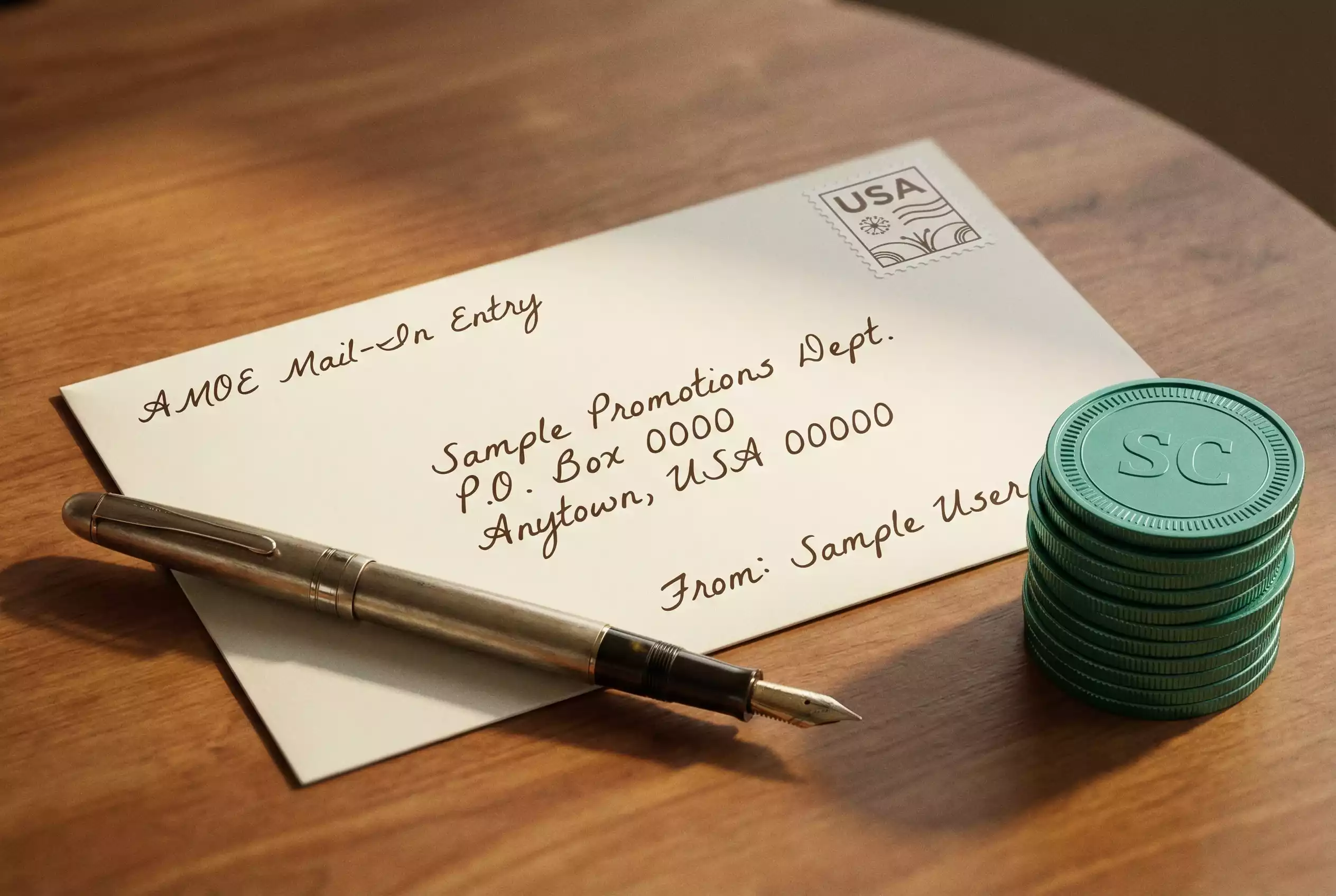
Introduction: What AMOE Is and Why It Matters Legally
AMOE — Alternative Method of Entry — is the legal backbone of every sweepstakes casino’s claim that no purchase is necessary to play. The concept is straightforward: you send a handwritten request by postal mail, and the casino credits free sweeps coins to your account. No gold coin purchase required, no credit card involved, no money exchanged in any direction. It’s the mechanism that separates a sweepstakes promotion from a gambling operation in the eyes of most state laws.
The existence of AMOE is what keeps the dual-currency model legally defensible. If the only way to get sweeps coins were to buy gold coin packages, the argument that SC aren’t tied to “consideration” — the legal term for payment — would collapse. AMOE provides the free-entry path that makes the sweepstakes structure viable. According to RG.org market research, only about 12 percent of sweepstakes casino players ever make a purchase, which means the vast majority already play for free through various channels. AMOE is the most formalized of those channels, and for players willing to invest a stamp and a few minutes of handwriting, it’s a reliable source of additional SC that most people overlook entirely.
Mail-In AMOE at Sweepstakes Casinos — More on this topic at social casino free sc.
How to Write a Valid AMOE Request (Step-by-Step)
The process is deliberately analog — handwritten letters, stamped envelopes, physical mail delivery — and every detail matters. Casinos reject requests that don’t follow their specific formatting instructions, and the rules aren’t always intuitive.
Start with the correct stationery. Most platforms require a standard 3×5 inch index card or a plain sheet of paper. Some specify that lined paper is acceptable; others insist on unlined. Check the casino’s official AMOE terms, typically found in the “Sweepstakes Rules” or “Official Rules” section of their website. Using the wrong paper format is one of the most common reasons for rejection.
Write the required information by hand. The universal requirements include your full legal name (matching your account registration), your complete mailing address, your email address associated with your account, and a statement explicitly requesting free sweeps coins. Some casinos require additional details: your date of birth, your username or account number, and a specific phrase like “I wish to receive Sweeps Coins to participate in the sweepstakes promotion.” The exact wording varies by platform, and using the wrong phrasing can result in rejection.
Place the card or letter in a standard #10 business envelope. Address the envelope to the AMOE mailing address specified in the casino’s rules. Affix proper postage — currently $0.78 for a standard first-class letter within the United States as of 2026. Do not include anything else in the envelope: no additional notes, no return mail requests, no cash or payment of any kind. The request must be clean and limited to the specified content.
Mail it. USPS first-class mail is the standard delivery method. Some players use certified mail for tracking purposes, though this adds cost and isn’t required. After mailing, the processing period begins — and this is where patience becomes part of the process.
AMOE Addresses and SC Amounts by Casino
Each sweepstakes casino maintains its own AMOE mailing address and sets its own SC credit amount per valid request. These addresses change periodically — some casinos rotate PO boxes or update addresses when they relocate operations — so always verify the current address from the casino’s official rules page before mailing.
Chumba Casino has one of the longest-running AMOE programs in the industry. The platform credits a small SC amount per valid request, and players are permitted to send one request per day. The SC-per-request is modest — typically in the range of 5 SC per valid letter — but daily eligibility means a committed player can generate meaningful SC volume over a month. Chumba’s AMOE address is published in the Official Sweepstakes Rules accessible from the site footer.
LuckyLand Slots, also operated by VGW, runs a separate AMOE program with its own mailing address and SC allocation. The structure mirrors Chumba’s — one request per day, fixed SC per letter — but the specific amounts and address differ. Players who use both platforms can submit to each independently, doubling their daily AMOE potential from a single trip to the mailbox.
Pulsz, WOW Vegas, and most other mid-to-large sweepstakes casinos offer AMOE programs with similar mechanics. The SC amounts range from 2 to 10 SC per valid request, with most platforms falling in the 3 to 5 SC range. Submission frequency limits vary: some allow daily requests, others cap at one per week or a set number per month. The frequency limit is the variable that affects total monthly yield most dramatically, so it’s worth checking before committing to a daily mailing routine for a platform that only accepts weekly submissions.
A critical note on verification: the name and address on your AMOE request must match your registered account. Casinos cross-reference incoming mail against their user database, and mismatches result in rejected requests with no notification. If you’ve moved recently, update your account address before sending AMOE letters from the new location.
Processing Times and Expected Returns
AMOE is not a fast SC source. The timeline from mailing a request to seeing SC in your account involves postal delivery, manual processing by the casino’s team, and account crediting — a chain that typically takes 7 to 14 business days from the date of mailing. Some platforms process faster; others take longer, particularly during high-volume periods or after a promotional event drives a spike in AMOE submissions.
The postal leg accounts for two to five days in each direction if you’re mailing within the continental United States. The casino’s internal processing adds another one to five business days. The total elapsed time means that a letter mailed on Monday of week one might not produce SC until the end of week two or later. This lag makes AMOE a planning-horizon strategy rather than an on-demand SC source. You’re mailing today for SC you’ll use in two weeks.
Tracking is limited. Standard first-class mail provides no delivery confirmation, so you won’t know whether your request arrived unless the SC appears in your account. If you mail three requests in a week and only two produce credits, it’s difficult to determine whether the third was lost in transit, rejected for a formatting error, or simply still processing. Certified mail with return receipt eliminates this uncertainty at a cost of roughly $4 per letter — which, given the SC value per request, usually isn’t worth the expense unless you’re troubleshooting a pattern of missing credits.
Batch your AMOE efforts for efficiency. If you’re submitting to multiple casinos, prepare all requests in one session: write the cards, address the envelopes, stamp them, and drop the batch at the post office. The per-letter effort drops significantly when you’re producing five or ten at once, and the combined SC yield from a multi-platform batch makes the time investment more defensible.
Is AMOE Cost-Effective? Stamp Math
The cost of an AMOE request is fixed and small: one first-class stamp ($0.78 in 2026), one envelope (roughly $0.05 if bought in bulk), and one index card ($0.02 to $0.05). Total out-of-pocket cost per request: approximately $0.85. The time cost — writing, addressing, stamping — runs about two to three minutes per letter once you’ve established a routine.
See also SC Value Per Dollar.
If a casino credits 5 SC per valid AMOE request, and SC redeems at roughly 1:1 for USD (the standard at most platforms), then you’re spending $0.85 to acquire $5.00 of redeemable value. That’s a return of nearly 6x your cash investment. Even factoring in the industry-wide payout rate of 65 to 70 percent — the share that operators return to players as redeemed SC prizes, according to RG.org — the economics are favorable. After playing through the SC at typical RTPs, the expected redeemable value of a 5 SC AMOE credit lands somewhere around $3.25 to $3.50. That’s still roughly 4x your stamp cost.
The math weakens at lower SC-per-request casinos. A platform that credits 2 SC per letter reduces your return to roughly $1.30 to $1.40 of expected redeemable value per $0.85 spent — still positive, but barely. At that level, the time cost becomes the binding constraint. If you value your time at anything above minimum wage, spending three minutes to net $0.50 of expected value might not qualify as a rational use of your day.
The optimal AMOE strategy is selective: focus on platforms that credit the highest SC per request and allow daily or near-daily submissions. Skip platforms where the SC amount is too low to justify the postage. And if you’re going to do it at all, commit to the routine — the value accumulates through repetition, not through one-off experiments.