
Introduction: Why KYC Exists in a Free-to-Play Model
Sweepstakes casinos market themselves as free-to-play platforms, which makes the moment they ask for a copy of your driver’s license feel like a jarring contradiction. You signed up to spin virtual slots with virtual coins — why does anyone need your Social Security number? The answer is that sweepstakes casino KYC verification exists not because of how you play, but because of what happens when you try to leave with real money.
The moment you redeem sweeps coins for cash prizes, the transaction triggers financial reporting obligations under US law. The casino is distributing monetary value, and federal anti-money-laundering regulations require them to verify who’s receiving it. This isn’t optional or platform-specific — it applies to every sweepstakes casino that processes prize redemptions. According to AGA research, 68 percent of sweepstakes casino players are primarily motivated by winning money, which means the majority of the player base will eventually encounter KYC as the gate between their SC balance and their bank account. Understanding what’s required, how long it takes, and what trips people up is worth your attention before you reach the cashout screen.
Sweepstakes Casino KYC Verification — More on this topic at social casino free sc.
Documents Required: ID, Address Proof, SSN
The document requirements are broadly consistent across platforms, though the specifics of what’s accepted and how you submit it vary enough to catch people off guard.
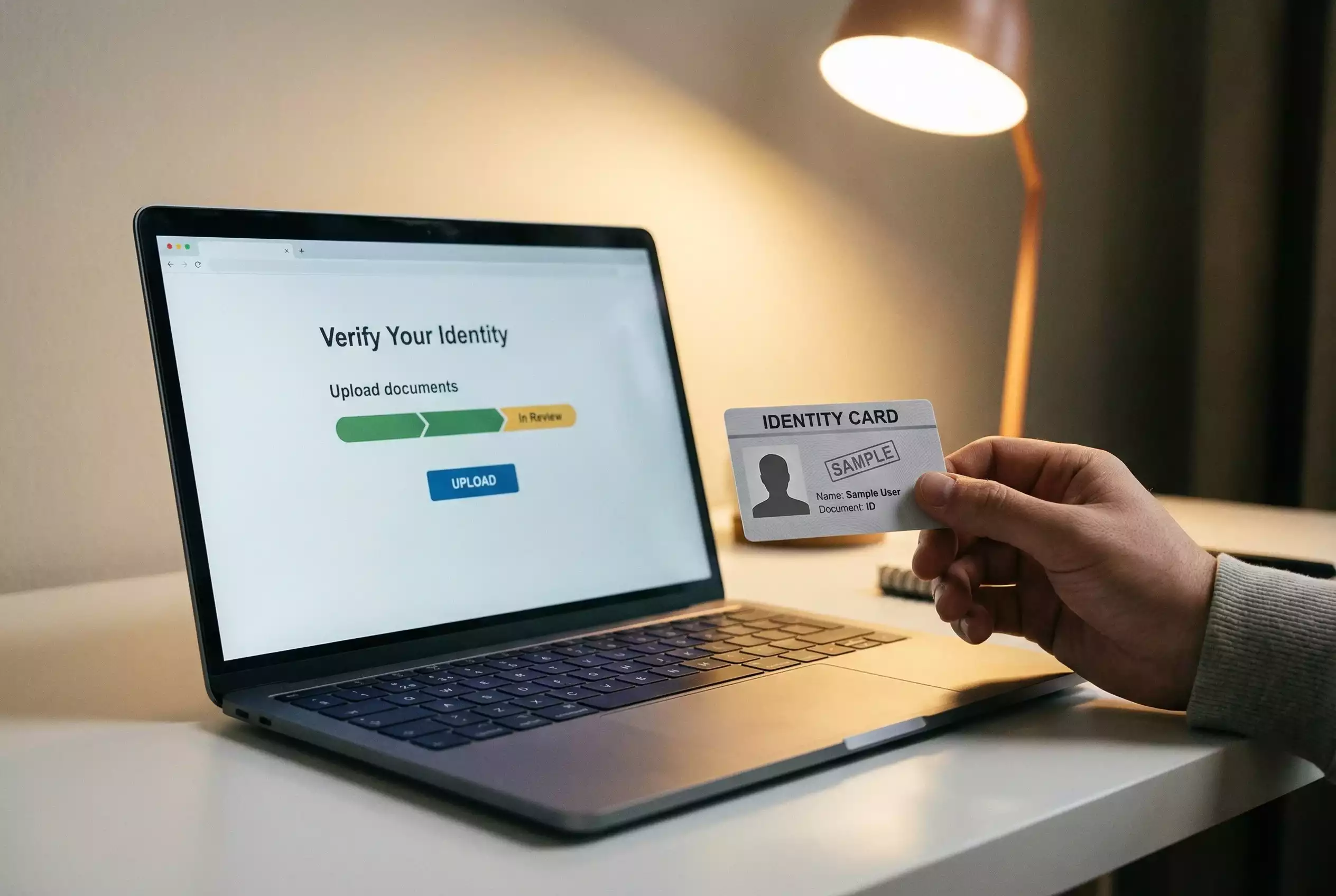
Government-issued photo ID is the universal requirement. Every sweepstakes casino that processes SC redemptions will ask for a scan or photograph of your driver’s license, state ID card, or passport. The document must be current — expired IDs are rejected without exception. Both sides of the ID are typically required for driver’s licenses and state IDs. Passports only need the photo page. The image must be legible, unobstructed, and show all four corners of the document. If you’re submitting via phone camera, overhead lighting works better than flash, which tends to create glare that obscures text.
Proof of address is the second layer. Platforms accept utility bills, bank statements, or official government correspondence dated within the last 60 to 90 days. The name on the document must match your account registration exactly. This is where mismatches create problems — if your electric bill is under a spouse’s name, it won’t satisfy the requirement even if you live at the same address. Some platforms also accept a recent credit card statement with your name and address visible, though you should redact the card number and any sensitive financial details before uploading.
Social Security number is requested by some — not all — sweepstakes casinos. The platforms that ask for it are typically the larger operators who issue 1099 tax forms for redemptions above certain thresholds. Under IRS rules, any entity distributing prizes worth $600 or more in a calendar year is required to report the payout and needs your SSN to do so. If a casino asks for your SSN during KYC, that’s a compliance signal, not a red flag. If a brand-new platform with no track record asks for it at registration before you’ve won anything, that warrants more caution.
A selfie holding your ID has become an increasingly common verification step, especially at platforms that use automated identity-matching software. The system compares your live photo against the ID photo to confirm the documents belong to you. If the selfie step is required, use good lighting, remove hats and sunglasses, and hold the ID next to your face with the photo side clearly visible. Automated systems reject submissions where the face is partially obscured or the ID is tilted at an angle.
KYC Process Timeline by Casino
Verification timelines range from near-instant to painfully slow, and the differences are driven by each platform’s verification infrastructure, staffing, and the volume of redemption requests they handle.
Chumba Casino, operated by VGW — a company that generated over $4 billion in revenue across FY2023-24, according to SBC Americas — processes an enormous volume of KYC submissions. The scale means the system is well-established, but it also means queue times can extend beyond what smaller platforms face. Typical KYC turnaround at Chumba runs one to three business days for straightforward submissions, stretching to five or more days during peak periods or when additional documentation is requested. Once verified, subsequent redemptions don’t require re-verification unless you change your address or payment method.
Pulsz has invested in semi-automated KYC that uses optical character recognition and facial matching to accelerate initial review. Clean submissions — sharp images, matching names, no discrepancies — can clear within hours. Submissions that require manual review fall into a one-to-two-day window. Pulsz also allows you to begin the KYC process before your first redemption attempt, which is a genuinely useful feature: complete verification when you’re not in a hurry, and your future cashouts process without the waiting period.
Stake.us, where accessible, processed KYC relatively quickly — often within 24 hours — partly because its crypto payout infrastructure reduced some of the banking-side verification steps. The trade-off was that Stake.us’s KYC process asked for crypto wallet verification in addition to standard identity documents, adding an extra step for players unfamiliar with blockchain wallets.
Smaller and newer platforms present the widest variance. Some use third-party verification services that clear submissions in minutes. Others rely on manual review by small teams, and turnaround can stretch to a week or longer. If a platform takes more than seven business days to process a clean KYC submission with no requested corrections, that’s a flag worth investigating through their support channels before investing more play time.
Common Rejection Reasons and Fixes
KYC rejections are frustrating but almost always fixable. The most common reasons fall into a predictable set of categories, and knowing them in advance lets you avoid the round-trip delay of submitting, getting rejected, and resubmitting.
Image quality issues account for the largest share of rejections. Blurry photos, reflective glare from camera flash, cropped edges that cut off document text, and images taken at steep angles all trigger automatic or manual rejections. The fix is straightforward: photograph your documents on a flat, well-lit surface using your phone’s camera at a perpendicular angle. Avoid flash. Make sure all text and the photo are legible at full zoom. If the file is larger than the platform’s upload limit, use your phone’s built-in compression rather than a third-party tool that might degrade quality.
Name mismatches are the second most common issue. If your account says “Robert Smith” but your driver’s license reads “Robert J. Smith,” some verification systems flag the discrepancy. The same applies to legal name changes, maiden names, and nicknames. The solution is to ensure your account registration matches your ID exactly — including middle initials, suffixes, and hyphens. If you registered with a name that doesn’t match your documents, contact support to update the account before resubmitting KYC.
Address discrepancies arise when your current address doesn’t match the address on your ID. This happens frequently after a recent move. Most platforms accept a utility bill or bank statement showing your current address alongside an ID with the old address, as long as you explain the discrepancy. Some require a secondary form of address proof, like a signed lease or mortgage statement. Updating your driver’s license to reflect your current address before initiating KYC eliminates this problem entirely.
Expired documents are an automatic rejection with no workaround. If your ID expires next month, complete KYC now. If it’s already expired, renew it before attempting verification. No sweepstakes casino accepts expired identification, regardless of how recently it lapsed.
Privacy: How Casinos Handle Your Data
Handing a sweepstakes casino copies of your most sensitive documents raises a legitimate question: what happens to that data after verification?
Most major platforms state in their privacy policies that KYC documents are encrypted during transmission and stored in secure environments with access restricted to verification personnel. The documents are typically retained for the duration of your account’s active life plus a compliance-mandated retention period that varies by jurisdiction — often five to seven years after your last activity. Deletion requests after account closure may be honored, but the platform can refuse if regulatory retention requirements override your request.
See also Best Daily Login Bonuses at Sweepstakes Casinos.
Third-party verification providers add another layer to the data chain. Platforms that use services like Jumio, Onfido, or similar identity verification companies are sending your documents to an external processor. These companies operate under their own privacy policies and data protection standards, which may differ from the casino’s. Reading both the casino’s and the verification provider’s privacy policies before submitting is prudent, though admittedly, few players do.
The practical risk calculus is straightforward. Large, established platforms with years of operations and thousands of verified players have a demonstrated record of handling sensitive data. New platforms with limited histories present higher uncertainty. If you’re uncomfortable providing KYC documents to a specific casino, that discomfort is valid information — and there are enough established alternatives that you don’t need to hand your passport scan to an unknown operator to participate in sweepstakes gaming.