
Introduction: The Hidden Math Behind Coin Packages
Every sweepstakes casino sells gold coin packages with bonus sweeps coins included, and every one of them structures the pricing to obscure the actual cost of those SC. The headline is always about the gold coins — “Get 200,000 GC for $19.99!” — while the SC component, which is the only part with redeemable value, is presented as a free bonus. This framing isn’t accidental. It’s the legal architecture of the dual-currency model, and it makes comparing sweeps coins value per dollar across platforms harder than it should be.
The question most players never think to ask is straightforward: when I spend $1 on a coin package, how many SC do I actually receive, and what is that SC worth once I play it through and redeem it? The answer varies by platform, by package size, by whether it’s your first purchase, and by the operator’s payout rate. Untangling those variables turns a casual buying decision into a math exercise — but it’s a math exercise that tells you exactly where your money goes.
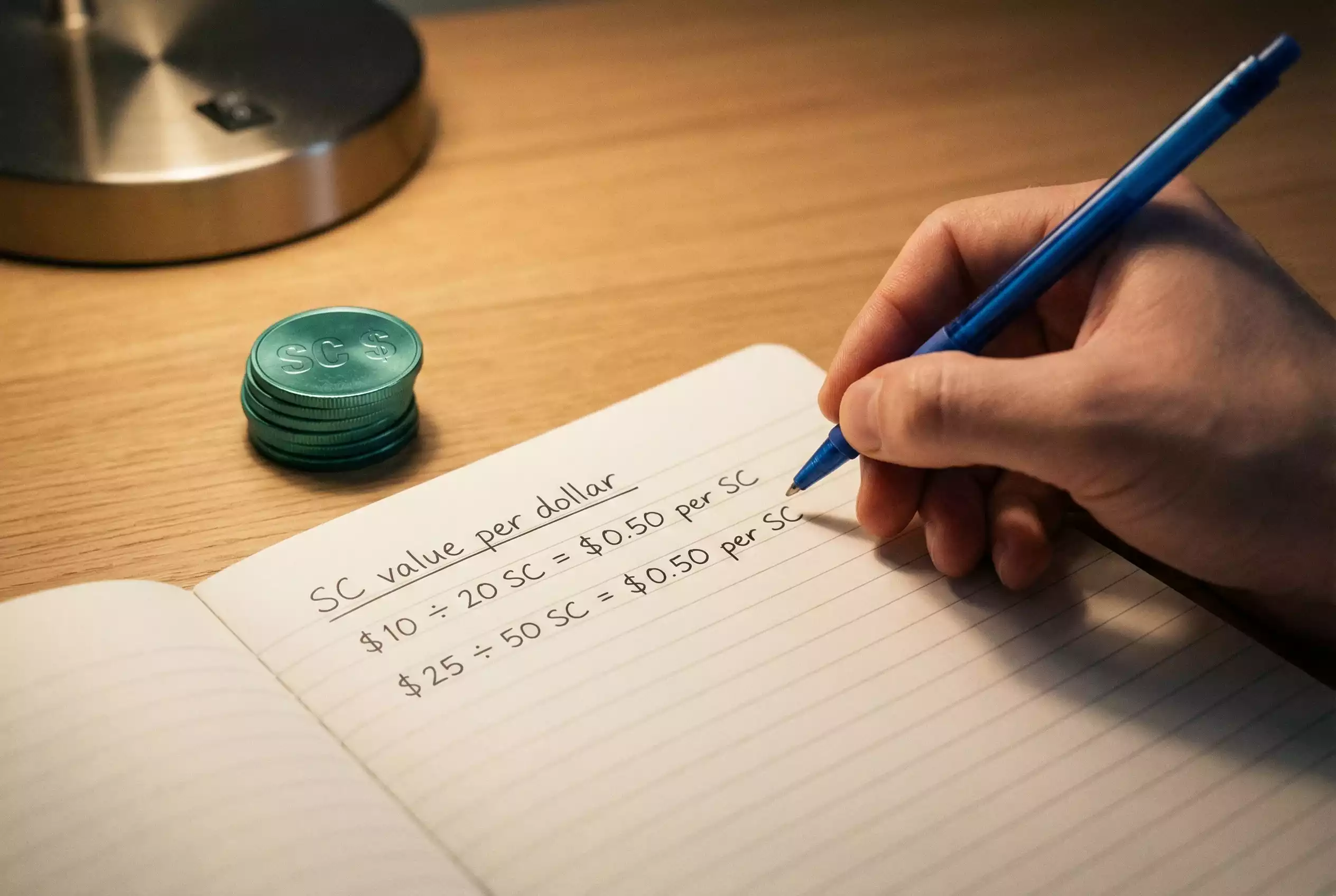
SC Value Per Dollar — More on this topic at social casino free sc.
First-Purchase Bonus SC per Dollar by Casino
First-purchase packages are always the best deal at every sweepstakes casino, and the margin isn’t close. Operators front-load SC value into the initial buy because converting a free player into a paying customer is the most important conversion event in their business model. According to GiG’s investor presentation data, the customer acquisition cost in the sweepstakes sector runs between $50 and $100 per player. A generous first-purchase bonus that costs the operator $5 to $15 in SC value is a small price to pay for a converted user.
Chumba Casino’s first-purchase offer typically provides a significant SC uplift relative to the package price. A $10 introductory package might include 2 to 3 SC at the standard rate but 10 or more SC as a first-purchase bonus. That’s a swing from roughly $0.20 to $0.30 per SC down to $1.00 or more per dollar — a three-to-five-fold improvement in SC per dollar spent. The first-purchase bonus structure changes periodically, so the specific numbers shift, but the pattern is consistent: your first dollar buys significantly more SC than any subsequent dollar.
Pulsz runs an even more aggressive first-purchase promotion during peak marketing periods, sometimes bundling 15 to 20 SC with introductory packages priced at $10 to $20. This translates to an effective SC cost as low as $0.50 to $0.70 per SC on the first purchase, compared to $1.50 to $3.00 per SC at standard rates. Pulsz also layers promo codes on top of first-purchase bonuses — if you stack correctly, the SC yield per dollar can exceed any other platform’s baseline offer.
Stake.us, WOW Vegas, and smaller platforms follow the same playbook with varying generosity. The common thread is that the first purchase is always subsidized, and the subsidy is substantial enough to make it the single most efficient SC acquisition event available to a paying player. If you’re going to spend money at a sweepstakes casino, the first purchase is where you get the most value — and subsequent purchases will never match it.
Regular-Purchase SC per Dollar (No Bonus)
After the first-purchase bonus evaporates, the SC-per-dollar ratio settles into a less flattering equilibrium. Standard coin packages across major sweepstakes casinos typically yield between 0.3 and 1.0 SC per dollar spent, with the exact ratio depending on the package tier.
Most platforms use tiered pricing that rewards larger purchases with better SC ratios. A $4.99 package might include 1 SC (roughly $0.20 per SC of package price), while a $49.99 package might include 15 SC (roughly $0.30 per SC). The scaling isn’t linear and varies by platform, but the general rule holds: bigger packages provide more SC per dollar. This is standard promotional economics — the casino wants you spending more per transaction, and the SC bonus is the incentive.
The headline GC number in each package is deliberately distracting. A $19.99 package advertised as “100,000 Gold Coins + 3 SC Bonus” trains your eye on the six-figure GC number while the actual value — 3 SC, worth roughly $3 at a 1:1 redemption rate — sits in smaller text. Evaluating packages exclusively by their SC component reveals the true cost. At $19.99 for 3 SC, you’re paying approximately $6.67 per SC before factoring in gameplay losses and the platform’s payout rate. That’s a number worth knowing before you click “Buy.”
Some casinos offer periodic return-buyer promotions — double SC weekends, holiday multipliers, or flash sales — that temporarily improve the standard SC-per-dollar ratio. These promotions are worth waiting for if you’re planning a purchase anyway. The SC yield during a double-SC event can approach first-purchase levels, turning a $20 package from a mediocre deal into a reasonable one.
Factoring in Payout Rate: The Effective Dollar Value
The SC-per-dollar ratio from a coin package is only half the equation. The other half is what happens to that SC once you play it. Not every SC you acquire will survive the journey from your balance to your bank account, and the platform’s payout rate tells you how much of the total SC economy actually reaches player wallets.
According to RG.org market research, sweepstakes operators return approximately 65 to 70 percent of gold coin purchases back to players as SC prizes. This figure encompasses the entire lifecycle: acquisition, gameplay, and redemption. It means that for every dollar entering the system through GC packages, roughly $0.65 to $0.70 eventually exits as redeemed SC cash.
Applying this to individual purchases makes the math concrete. If you spend $20 on a coin package and receive 5 SC, those 5 SC have a face value of $5.00 at the standard 1:1 redemption rate. But after playing through at typical slot RTPs and accounting for the operator’s margin, the expected redeemable value drops to approximately $3.25 to $3.50 — the 65 to 70 percent payout rate applied to your SC. Your effective return on the $20 purchase is $3.25 to $3.50 in expected cashable value, which means the real cost per “surviving” SC dollar is closer to $5.70 to $6.15.
This math isn’t meant to discourage purchasing — it’s meant to clarify the exchange rate. Knowing that a $20 coin package yields roughly $3.50 of expected redeemable value lets you evaluate whether that entertainment-plus-prize value is worth $20 to you. For some players, the gameplay hours are worth the cost even if the redemption return is modest. For others, the numbers clearly say to stick with free SC sources and skip purchases entirely.
When Purchasing Makes Sense (and When It Doesn’t)
The decision to buy gold coin packages should be made with the effective math in mind, not the marketing copy. There are scenarios where purchasing is reasonable and scenarios where it clearly isn’t.
Purchasing makes sense when you’ve exhausted free SC sources and want to extend play time for entertainment value, treating the cost as you would a movie ticket or a night out. It makes sense when a first-purchase or promotional bonus significantly improves the SC-per-dollar ratio, temporarily closing the gap between what you spend and what you might redeem. And it makes sense when you’ve established a comfortable budget — money you can lose entirely without financial stress — and view the SC as a bonus rather than a return on investment.
See also Responsible Gaming at Sweepstakes Casinos.
Purchasing doesn’t make sense when you’re chasing losses, spending more to recover a depleted SC balance in hopes that the next session will reverse the trend. It doesn’t make sense when you haven’t compared the SC yield across packages and platforms, because paying $20 for 3 SC at one casino when another offers 5 SC for the same price is money left on the table. And it doesn’t make sense when free sources — daily logins, AMOE, social media giveaways, referrals — haven’t been fully utilized. Every free SC you leave unclaimed is money you didn’t have to spend.
The clearest indicator that purchasing has crossed from entertainment to problem behavior is if you find yourself buying coin packages to fund sessions rather than treating purchases as occasional enhancements to a primarily free-play routine. Sweepstakes casinos are designed to be enjoyable without spending. The moment purchases feel necessary rather than optional, the value proposition has inverted — and it’s time to recalibrate.